Key facts
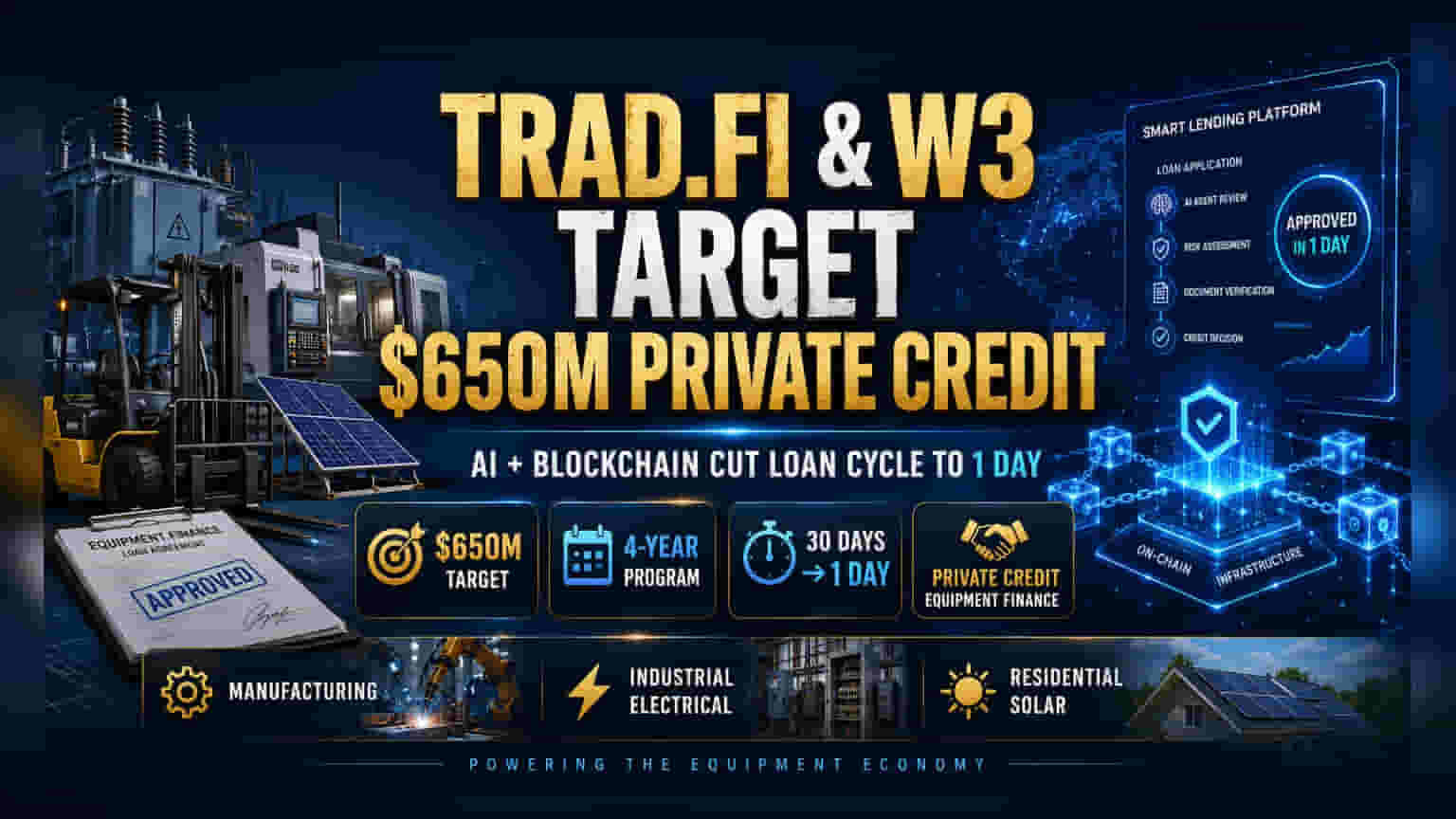
- Trad.Fi and W3 aim to raise $650 million for onchain private credit.
- The initiative will leverage AI for risk assessment, due diligence, and loan pricing.
- The credit will be backed by tangible equipment loans as collateral.
- The goal is to reduce loan approval times from weeks to one business day.
- US investors will be excluded from the initial investment pool.
US-based equipment finance platform Trad.Fi announced plans to bring up to $650 million in private credit onchain over the next 48 months, targeting the trillion-dollar US market for manufacturing equipment, industrial systems, and residential solar installations. The initiative aims to reduce digital credit approval times to a single business day, a significant acceleration from the weeks or months typically required for traditional financing.
The $650 million represents a credit pipeline to be minted onchain, secured by committed senior credit facilities and signed Letters of Intent from borrowers. Trad.Fi currently has approximately $85 million in signed term sheets and expects about $40 million to close imminently. The company's CEO, Alexander Szul, highlighted the need to move capital, records, and workflows onto programmable rails to overcome financing bottlenecks.
Investors will gain exposure to the equipment-finance loans through an onchain investment pool, which will be operated by an unnamed third party and is expected to launch soon. US-based investors will not be eligible during the initial phase. W3 will supply the infrastructure for tokenizing loans and managing credit records across the Base, Arc, and Avalanche blockchains, though legal agreements will remain offchain.
This initiative contributes to the growing market for tokenized real-world assets (RWAs), which has seen a recent cooling. Tokenized US Treasury debt represents a significant portion of the RWA market, while tokenized corporate credit is a smaller segment. Challenges for the sector include ensuring the reliability of AI-based risk assessment over economic cycles, navigating evolving legal and regulatory frameworks for tokenized debt, and encouraging business adoption of blockchain-integrated lending.