All NewsEducationTVBrokers
Equities & FundsCrypto & Digital AssetsAI & TechnologyBusiness & CorporateUS Politics & PolicyGeopolitics & Global RiskMacro, Rates & FXCommodities & EnergyEuropean Politics & MarketsAsia-PacificReal Estate & Property
All NewsHome
← Back to US Politics & Policy

Supreme Court allows Trump's White House ballroom construction to continue

Created at 31 Aug · 8:12 PM1 source↑ Market-relevant
IN SHORT

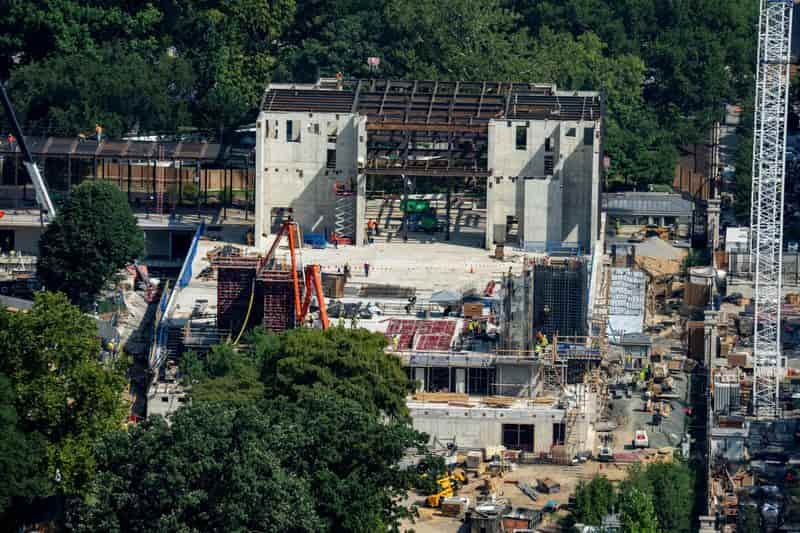
The U.S. Supreme Court has allowed Donald Trump's administration to continue construction of a White House ballroom project, granting a request to block a lower court's order that would have halted above-ground development. The project is estimated to cost $400 million.

Key Numbers

5-4Supreme Court ruling vote count
$400 millionWhite House ballroom project cost
90,000-square-footballroom size
65%East Wing project completion

Who's Involved

Supreme Court
granted administration's request to block lower court order
Donald Trump
administration challenging judicial order on White House ballroom
National Trust for Historic Preservation
sued to stop White House ballroom project
Richard Leon
U.S. District Judge who issued initial order
U.S. Court of Appeals for the District of Columbia Circuit
upheld district judge's order to halt above-ground construction
Supreme Court allows Trump's White House ballroom construction to continue

↳ Why This Matters

The Supreme Court's decision allows a significant White House construction project to continue, impacting national security infrastructure and raising questions about presidential authority versus congressional oversight in altering federal landmarks.

Key facts

  • The Supreme Court allowed construction of Donald Trump's White House ballroom project to continue.
  • The ruling was a 5-4 decision by the justices.
  • The project is a $400 million ballroom intended to enhance security.
  • A historic preservation group sued to stop the construction, arguing it lacked congressional approval.
  • The D.C. Circuit Court of Appeals had previously upheld a lower court's order to halt above-ground construction.

The U.S. Supreme Court has permitted Donald Trump's administration to proceed with construction of a White House ballroom project, temporarily blocking a judicial order that sought to halt significant development. The 5-4 ruling allows above-ground construction to continue while legal challenges proceed.

The National Trust for Historic Preservation sued to stop the $400 million project, which involves building a 90,000-square-foot ballroom. The group argues that the administration lacks the unilateral authority to undertake such a substantial alteration of the White House without explicit congressional approval.

Justice Department lawyers contended that the ballroom, integrated with an extensive underground complex featuring security enhancements, is a national security necessity. They cited threats against the president and stated the overall East Wing project is 65% complete.

Previously, the U.S. Court of Appeals for the District of Columbia Circuit had upheld a district judge's order. This ruling allowed below-ground construction and work deemed strictly necessary for security to continue, but blocked above-ground efforts, stating that national security arguments do not automatically override legal requirements for congressional approval.

Trump has publicly criticized the lower court's decision, calling it "horrendous" and politically motivated, and asserting that it leaves him and others exposed to attack. The National Trust urged the Supreme Court to reject the administration's request, emphasizing that multiple courts have agreed the administration lacks the authority to proceed without congressional consent.

Frequently asked questions

It is a $400 million project to construct a new 90,000-square-foot ballroom integrated with an extensive underground complex at the White House East Wing, intended to enhance security.

The group argues that the Trump administration lacks the unilateral legal authority to build the ballroom without specific approval from Congress.

In a 5-4 ruling, the Supreme Court allowed above-ground construction to continue while the legal challenge proceeds, blocking a lower court's order.

The administration claims the ballroom and underground complex are vital for the security of the president and visitors, citing threats and the need for features like bomb shelters and drone shielding.

What Happens Next

01The lawsuit challenging the construction project will proceed.
02The Supreme Court may eventually rule on the merits of the case.

How It Developed

The Supreme Court granted the administration's request to block a lower court's order halting above-ground construction of the ballroom.
The National Trust for Historic Preservation sued after the administration began building the ballroom without specific congressional approval.
The D.C. Circuit upheld a district judge's order to halt above-ground construction while allowing below-ground work.
The Justice Department stated the overall East Wing project is 65% complete.
Trump cited national security necessity for the project, calling the D.C. Circuit's decision politically motivated.

Sources

T1
Supreme Court lets Trump's White House ballroom construction continue for nowReuters

Related Stories

Judge rules Trump-era visa cancellations for pro-Palestinian speech unconstitutional
31 Aug · 9:51 AM
Trump administration to announce new drug pricing deals
31 Aug · 4:12 PM
US Expected to Grant Biofuel Waivers, Boosting Refiners Amid Low Oil Reserves
31 Aug · 10:06 AM
Trump Approval at 33% as Democrats Show Higher Enthusiasm for Midterms
31 Aug · 7:17 PM
Trump reviewing US position on Falkland Islands
31 Aug · 8:38 PM