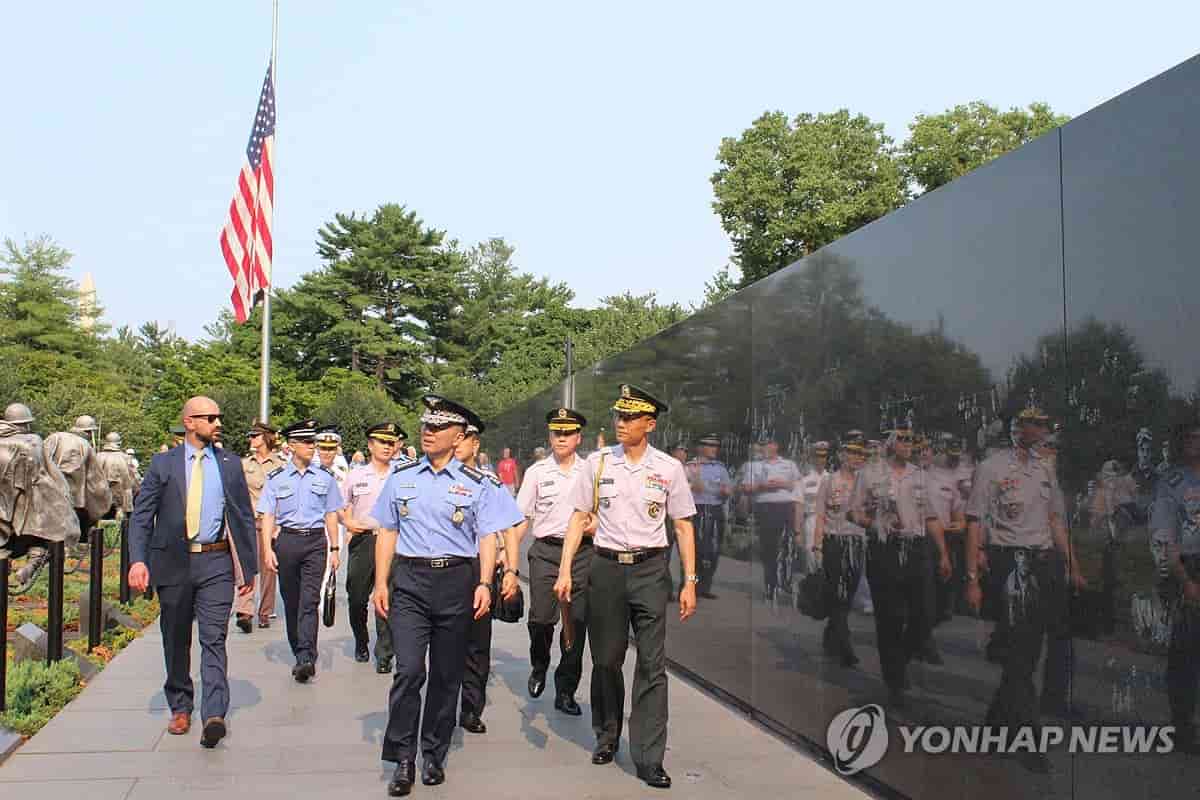
The top military officers of South Korea, the United States, and Japan reaffirmed their commitment to trilateral security cooperation to counter regional challenges, including North Korean nuclear and missile threats. The meeting took place at the Pentagon.

The reaffirmation of trilateral security cooperation among South Korea, the U.S., and Japan underscores a unified front against North Korean provocations and broader regional instability, signaling continued strategic alignment in the Indo-Pacific.
The top military officers of South Korea, the United States, and Japan reaffirmed the critical importance of their three-way security cooperation in addressing regional challenges, particularly North Korea's nuclear and missile threats. This consensus was reached during the Trilateral Chiefs of Defense (Tri-Chod) meeting held at the Pentagon near Washington on Wednesday, July 15, 2026.
South Korean Joint Chiefs of Staff (JCS) Chairman Gen. Jin Yong-sung met with his U.S. counterpart Gen. Dan Caine and Japanese counterpart Gen. Hiroaki Uchikura. According to a joint statement released by the South's JCS, the leaders agreed that their cooperation is key to effectively responding to various regional challenges and threats that impact peace and stability on the Korean Peninsula, the Indo-Pacific, and beyond.
The officers committed to continuing efforts toward the complete denuclearization of North Korea, aligning with U.N. Security Council resolutions. They also agreed to deepen cooperation across multiple domains and explore ways to maintain momentum for their security collaboration, including through their annual Freedom Edge trilateral exercise.
In separate bilateral discussions, Jin and Caine emphasized strengthening the combined defense posture to counter North Korea's evolving threats and the changing security environment. They pledged to advance combined operational capabilities through joint drills and high-level military exchanges. Jin also met with Uchikura to discuss enhancing exchanges based on mutual trust, close communication, and improved information sharing.
Attendees at the Tri-Chod meeting also included U.S. Forces Korea Commander Gen. Xavier Brunson, U.S. Forces Japan Commander Lt. Gen. Stephen Jost, and Deputy Commander of the U.S. Indo-Pacific Command Lt. Gen. George Rowell. The military leaders agreed to convene their next trilateral meeting in Japan in the following year.