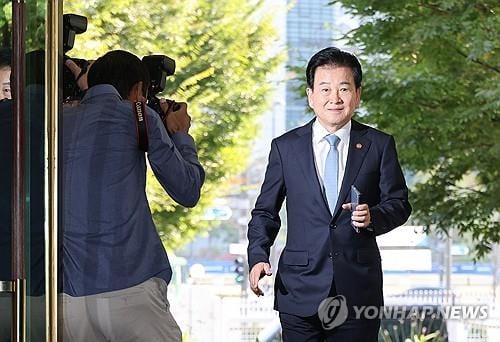
SEOUL, Oct. 12 (Yonhap) -- Unification Minister Chung Dong-young on Monday sought to quell concerns that the alliance between South Korea and the United States is fraying, asserting that the two nations share fundamental values despite occasional divergences in their interests.
Chung's remarks came as he faces criticism from the opposition, which has accused him of undermining the alliance. These accusations stem from controversy over U.S. restrictions on intelligence-sharing with South Korea, following his past comments about a suspected North Korean uranium enrichment facility in Kusong, among other issues.
"An alliance shares values, but interests can be aligned or conflicting," Chung told reporters. "There is absolutely nothing wrong with the South Korea-U.S. alliance right now. What is wrong with it?"
He emphasized that Seoul cannot simply accept every demand from Washington, noting that U.S. allies, like South Korea, strive to protect their own national interests and autonomy.
Chung characterized a recent summit in New York between President Lee Jae Myung and U.S. President Donald Trump as a "milestone" in advancing South Korea's national interests.
Regarding the intelligence-sharing dispute, Chung suggested it arose from a misunderstanding, clarifying that his remarks about the Kusong facility were made in July of the previous year, when he was a lawmaker, not a government minister. He stated that he had explained the circumstances to U.S. officials and requested the South Korean ambassador to the United States to provide further explanation.
On Sunday, the National Intelligence Service (NIS) confirmed that while certain areas of intelligence cooperation faced restrictions, overall collaboration between South Korea and the U.S. on matters concerning North Korean missiles and conventional military capabilities continued. The NIS also refuted reports indicating a decrease in the volume of intelligence provided by Washington.
Chung dismissed calls for his dismissal, as well as those for NIS Director Lee Jong-seok, labeling them as "ideological smear" and stating that "ideological labeling" should be rejected in 2026.
Furthermore, Chung defended his earlier assessment of a land mine explosion in the Demilitarized Zone (DMZ) on September 21 as an accident. He reiterated that it remained difficult to definitively determine if the incident was a deliberate attack by North Korea. Chung pointed to differing reference lines used by South and North Korea and the U.N. Command (UNC), emphasizing the need to align military demarcation lines and prevent future occurrences.
This characterization had drawn criticism, as the Joint Chiefs of Staff (JCS) had previously stated that its investigation with the UNC concluded that mines planted by North Korea caused the explosion, which injured three South Korean soldiers. The JCS had deemed the mine-laying a violation of the Armistice Agreement and called for an apology from Pyongyang, which North Korea has denied, warning of retaliation.