Key facts
- Morocco and Israel agreed to upgrade their diplomatic missions to embassies and appoint ambassadors on September 16.
- The deal includes agreements on investment protection and double taxation.
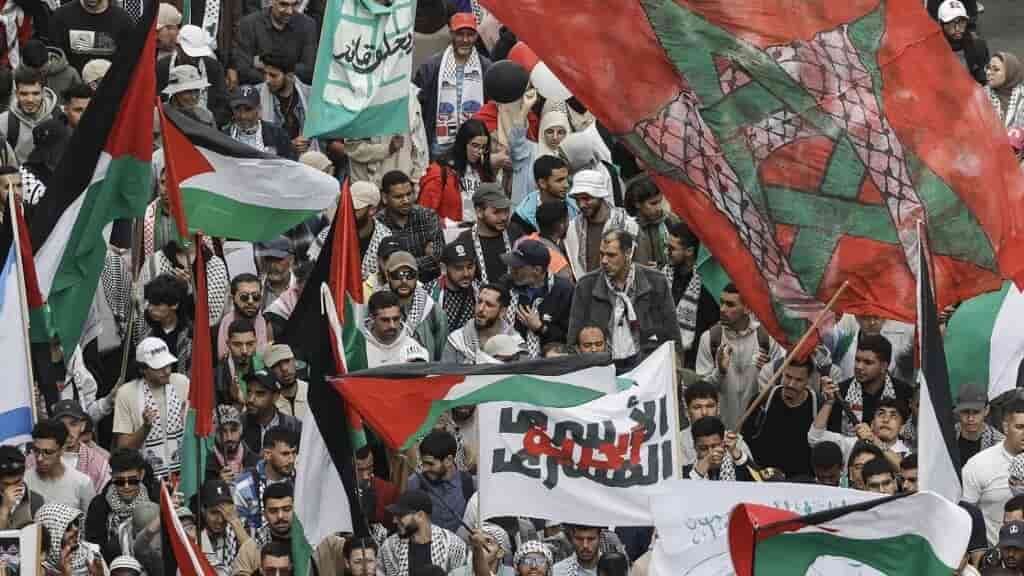
- The Moroccan public largely supports Palestine and condemns normalization with Israel.
- The US, Israel, and Morocco stated the agreement reaffirms the Abraham Accords.
- The Justice and Development Party (PJD) is the only political party openly denouncing the growing ties.
- Al Adl Wal Ihsane, an Islamic movement, also condemned the deepening of relations.
Morocco and Israel have agreed to advance their bilateral relations by upgrading their respective missions to embassies and appointing ambassadors, following a meeting between Israeli Foreign Minister Gideon Saar and his Moroccan counterpart Nasser Bourita on September 16. The agreement, which also includes provisions for investment protection and double taxation to be finalized by year-end, comes despite strong public support for Palestine within Morocco and condemnation of normalization with Israel.
The joint statement from the US, Israel, and Morocco highlighted that the new agreement "reaffirms the spirit of the Abraham Accords" and that full diplomatic relations are in the "common interest" to "advance peace and unlock new opportunities for the entire region."
While the Justice and Development Party (PJD), an Islamic-oriented political movement, was in power when Morocco initially signed the Abraham Accords in 2020, members like Hassan maintain this did not contradict the party's pro-Palestine stance, attributing the decision on international affairs to the king. Hassan noted that the current government was in a caretaker phase preparing for general elections on September 23, further emphasizing the king's authority over such matters.
The PJD is the only political party to openly denounce the growing ties, issuing a statement reiterating its opposition to any normalization with Israel. Similarly, the Islamic movement Al Adl Wal Ihsane condemned the move, with Dr Boubker El Ounkhari stating it was a "blatant affront to Moroccans’ sentiments and a provocation against the popular will."
Members of the current governing coalition, including the National Rally of Independents (RNI), Authenticity and Modernity Party (PAM), and Istiqlal Party, have remained publicly silent. An RNI member, Mohamed, described the internal reaction as "rationality and calmness," noting that Moroccan-Israeli relations have been an established part of foreign policy since 2020. A PAM member indicated that the party would avoid commenting on the deal to prevent it from being used against them during the election campaign.
The Moroccan government has framed the strengthened ties as a means to assist Palestinians, with the foreign minister stating Rabat does not agree with Israel on all points. This narrative echoes the justification used for deploying military aid to the International Stabilisation Force in Gaza under a previous US plan. Mohamed suggested that Morocco could leverage its relationship with Israel for diplomatic dialogue and to advance a two-state solution, though he acknowledged that cooperation doesn't automatically benefit Palestinians.
Ahmed Ouihmane, president of the Moroccan Observatory Against Normalisation, dismissed the government's justification as "nonsense and an insult to the intelligence of the Moroccan people," questioning the tangible results for Palestinians given the ongoing conflict and death toll. He argued that real aid would involve denying the Israeli war machine any form of cooperation, citing Morocco's role as a transit point for military cargo to Israel.
The timing of the announcement is particularly sensitive, occurring amidst other domestic issues and ahead of elections. The RNI member cited strategic interests, diplomacy, economics, security, energy, and US support for the Sahara issue as justifications for continued relations, referencing the US recognition of Moroccan sovereignty over Western Sahara in exchange for the Abraham Accords signing. Hassan from PJD also views Western Sahara as a core motive, suggesting state geopolitical calculations sometimes override popular will. However, pro-Palestinian advocates maintain that no justification warrants ties with Israel, emphasizing the universal rights of peoples.