Key facts
- Medicare Advantage plans frequently deny requests for short-term nursing home or inpatient rehabilitation services.
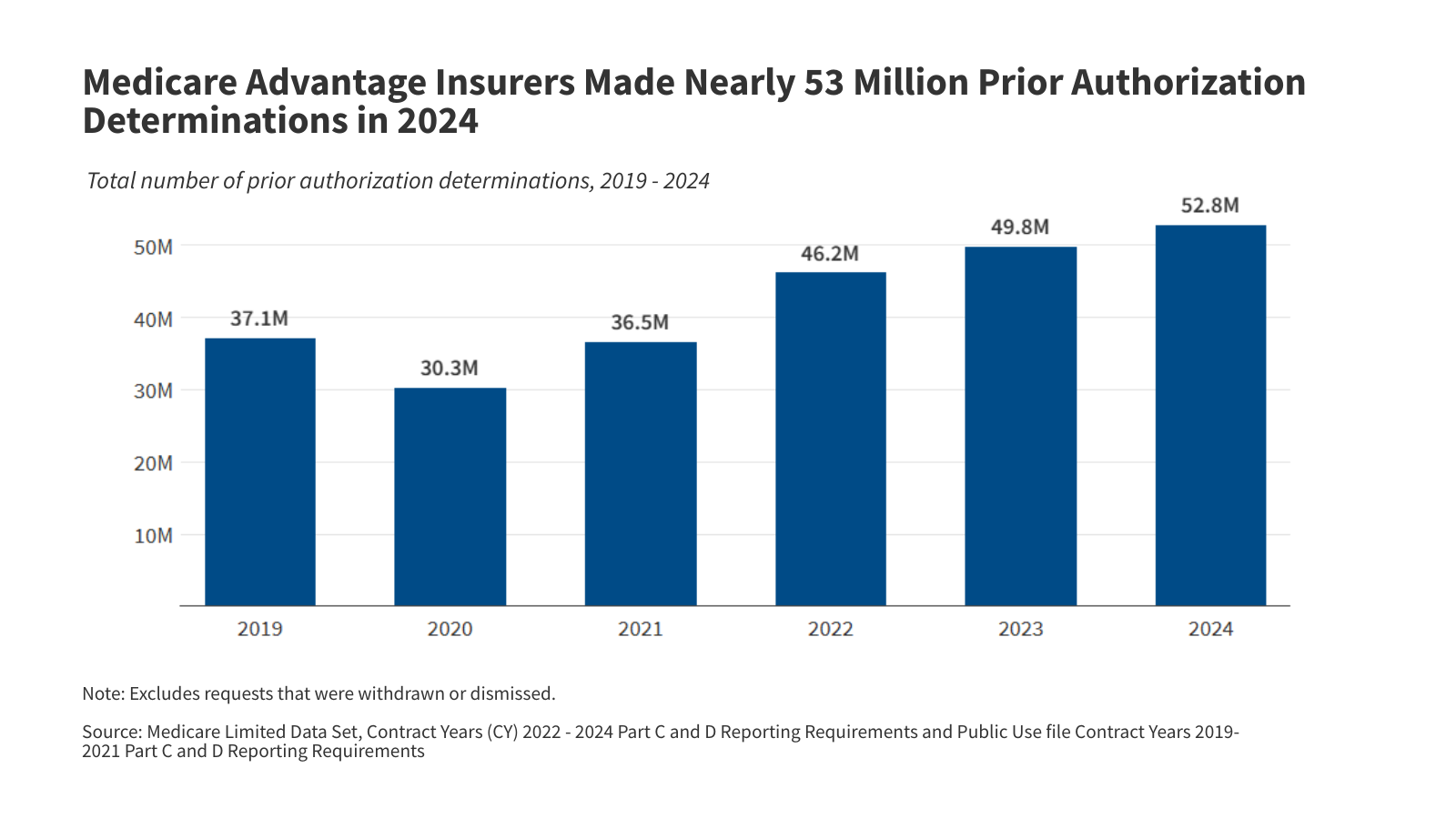
- In 2024, nearly 53 million prior authorization requests were submitted to Medicare Advantage insurers.
- Approximately 7.7% of prior authorization requests were denied by Medicare Advantage insurers in 2024.
- Three major Medicare Advantage insurers—UnitedHealthcare, Humana, and CVS—are using prior authorization to boost profits by denying post-acute care.
- UnitedHealthcare's denial rate for post-acute care increased significantly between 2020 and 2022.
- CVS utilized AI to reduce spending on skilled nursing facilities and increased prior authorization requirements.
Medicare Advantage plans are frequently denying beneficiaries access to necessary short-term nursing home or inpatient rehabilitation services, according to an analysis of investigator reports and insurer data. These denials are often driven by profit motives, with insurers utilizing prior authorization processes, including artificial intelligence, to reduce costs.
Virtually all Medicare Advantage enrollees, 99%, are required to obtain prior authorization for some services, typically higher-cost ones like inpatient hospital stays and skilled nursing facility stays. This contrasts with traditional Medicare, where prior authorization is required for a more limited set of services. In 2024, Medicare Advantage insurers received nearly 53 million prior authorization requests, a slight increase from the previous year. Of these, 4.1 million requests were fully or partially denied, representing 7.7% of all requests.
An investigation by the U.S. Senate Permanent Subcommittee on Investigations (PSI) found that three of the largest Medicare Advantage insurers—UnitedHealthcare, Humana, and CVS—use prior authorization to target denials for post-acute care, such as stays in skilled nursing facilities and inpatient rehabilitation facilities, in order to boost their profits. The PSI report, based on over 280,000 pages of documents, revealed that between 2019 and 2022, these companies denied prior authorization requests for post-acute care at significantly higher rates than for other types of care.
Specifically, UnitedHealthcare's prior authorization denial rate for post-acute care surged from 10.9% in 2020 to 22.7% in 2022, coinciding with the implementation of automated prior authorization processes. CVS saw a 57.5% increase in post-acute care service requests subjected to prior authorization between 2019 and 2022, a rate higher than its enrollment growth. CVS also deployed artificial intelligence in April 2021 to reduce spending on skilled nursing facilities.