Key facts
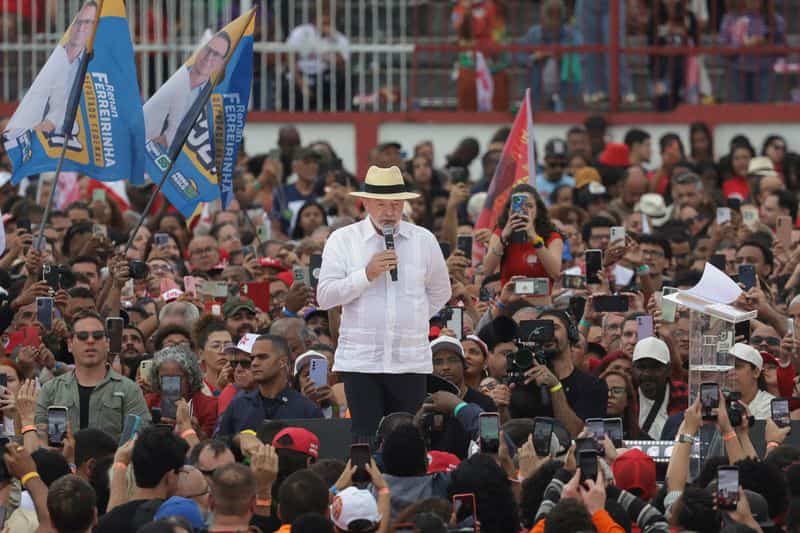
- President Luiz Inacio Lula da Silva and challenger Flavio Bolsonaro are in a technical tie ahead of Brazil's October election.
- Lula's campaign is unusually cautious due to concerns over misinformation and foreign interference.
- A Quaest poll shows Lula with 42% and Bolsonaro with 41% in a simulated second-round runoff.
- In the first round, Lula leads with 37% and Bolsonaro with 30%, with Augusto Cury in third at 10%.
- Both candidates have faced social media controversies regarding alleged corruption and payments.
Brazilian President Luiz Inacio Lula da Silva's lead over right-wing challenger Senator Flavio Bolsonaro has narrowed ahead of the October election, with the two candidates in a technical tie, according to a Quaest poll commissioned by Globo. In a simulated second-round runoff, Lula would receive 42% of the vote compared to 41% for Bolsonaro, the eldest son of former President Jair Bolsonaro. A previous Quaest poll released on August 14 showed Lula leading Bolsonaro 43% to 40%. In a first-round scenario, Lula would lead with 37% of the votes, followed by Bolsonaro at 30%. Psychiatrist Augusto Cury is in third place with 10% of the votes, a position he has held in three major surveys this week due to increased TV appearances and social media presence. If no candidate secures more than 50% of valid votes in the first round, the top two frontrunners advance to a runoff election. The Quaest poll surveyed 2,004 people between August 30 and September 1, with a margin of error of 2 percentage points.
President Lula is running a notably cautious campaign, with advisers citing concerns about misinformation, foreign interference, and the potential for damaging political narratives to spread rapidly, especially with the rise of artificial intelligence. This caution extends to government actions, with officials vetting announcements to avoid accusations of using state resources for political purposes. Ministers have been asked to delete social media posts, and state television has ceased broadcasting presidential events to comply with electoral law. Despite these measures, Lula faced a social media controversy after photos resurfaced showing him with a lobbyist under investigation for corruption. Senator Bolsonaro has also dealt with controversy, including revelations of a significant payment from a disgraced former banker investigated for corruption.
Lula's campaign views the environment as challenging, noting the rise of AI and a perceived U.S. administration willingness to interfere in regional elections. Analysts suggest that the intense polarization between the two main candidates contributes to voter fatigue and apathy, with many voters finding both options familiar. Brazil's electoral court has also implemented rules limiting content reach on social media platforms, confining campaign engagement to echo chambers, which may benefit the leading candidates by maintaining their established support bases.