Key facts
- The IRGC is a deeply conservative organization that has underpinned Iran's establishment for decades.
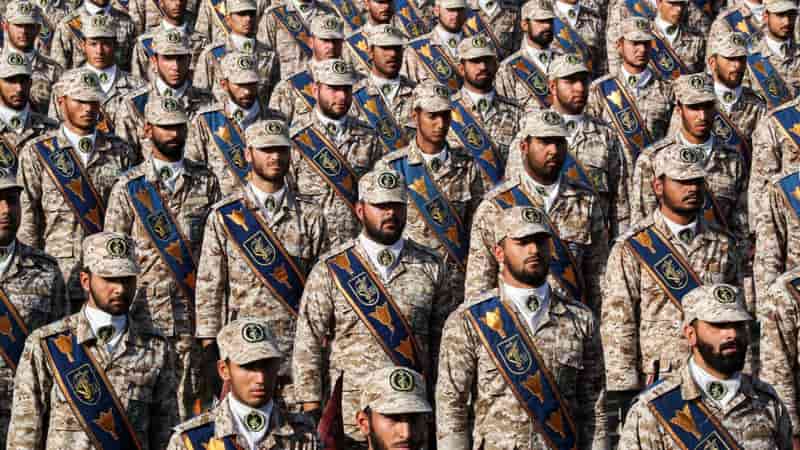
- The IRGC has hundreds of thousands of troops distinct from Iran's official army.
- The IRGC controls Iran's ballistic missiles and is tasked with safeguarding border security and nuclear facilities.
- The IRGC holds hundreds of government contracts and receives an estimated 50 percent of revenues from Iran's oil sector.
- Through its Quds Force, the IRGC funds and supplies regional groups like Hamas, Hezbollah, Hashd al-Shaabi, and the Houthis.
- The US banned the IRGC in 2019, and Canada and the EU followed suit in 2024 and 2026 respectively.
The Islamic Revolutionary Guard Corps (IRGC), often described as a 'state within a state,' is a powerful and deeply conservative organization that has been instrumental in maintaining Iran's political establishment for decades. Founded in March 1979 by conservative militias following the overthrow of the Shah, its primary purpose was to protect the new revolutionary order and to serve as a counterbalance to the regular Iranian army, which was perceived as potentially loyal to the old regime.
The IRGC operates with distinct military branches, including ground forces, an air force, a navy, the elite Quds Force focused on overseas operations, and the Basij, a volunteer paramilitary force. It commands an estimated 150,000 active personnel, supplemented by a large number of Basij volunteers. This force structure is larger than Iran's official army, known as Artesh, which has approximately 600,000 troops. The IRGC also holds significant strategic responsibilities, including control over Iran's ballistic missile program, which has been used in attacks against Israel, and the safeguarding of the country's border security and nuclear facilities.
Domestically, the IRGC's influence extends beyond military affairs into various aspects of Iranian life, including business, politics, education, and sports. Many veterans of the IRGC hold influential positions in government and parliament, impacting business ventures and career progression. The Basij force, through its volunteers in neighborhoods and educational institutions, acts as a de facto morality police, enforcing conservative religious values and suppressing political dissent, as seen in crackdowns on protests. However, the IRGC also provides social services and employment, garnering support in some segments of the population. Economically, the IRGC controls numerous government contracts, particularly those awarded during the presidency of Mahmoud Ahmadinejad, leading to monopolies in various industries and an estimated 50% share of revenues from Iran's oil sector. This economic power allows the IRGC to consolidate its influence and ensure its continued survival within the existing political framework.
Internationally, the IRGC, primarily through the Quds Force, actively supports and funds a network of regional groups referred to as its 'Axis of Resistance.' These include Hamas in Palestine, Hezbollah in Lebanon, elements of the Hashd al-Shaabi in Iraq, and the Houthis in Yemen. These groups aim to counter Israeli, US, and Saudi influence in the Middle East. While these proxies retain a degree of independence, with Tehran sometimes denying direct involvement in their actions, their activities, such as Hamas's October 7, 2023 attacks and the Houthis' Red Sea disruptions, have significant regional and global implications. The IRGC also provided crucial support to Bashar al-Assad's regime in Syria.
The IRGC's power grew significantly through its role in suppressing internal rebellions and its extensive involvement in the Iran-Iraq War (1980-1988). This conflict shaped the IRGC's worldview, fostering a sense of self-reliance and a need for robust defense capabilities. Following the war, the IRGC took on reconstruction roles and expanded its intelligence capabilities. The international network was largely built under Qassem Soleimani, who led the Quds Force from 1998 until his assassination by the US in 2020. His killing had a profound impact on the IRGC, leading to the accidental downing of a Ukrainian passenger plane shortly after.
Many governments, including those in the West and several Arab nations, view the IRGC as an adversary, leading to extensive sanctions. The US designated the Quds Force as a terrorist group in 2007 and the IRGC itself in 2019. Canada and the EU have since followed suit, designating the IRGC as a terrorist organization.