All NewsEducationTV
Equities & FundsCrypto & Digital AssetsAI & TechnologyBusiness & CorporateUS Politics & PolicyGeopolitics & Global RiskMacro, Rates & FXCommodities & EnergyEuropean Politics & MarketsAsia-PacificReal Estate & Property
All NewsHome
← Back to AI & Technology

Google rolls out anti-motion sickness feature on Android

Created at 25 Aug · 6:36 PM1 source↑ Market-relevant
IN SHORT

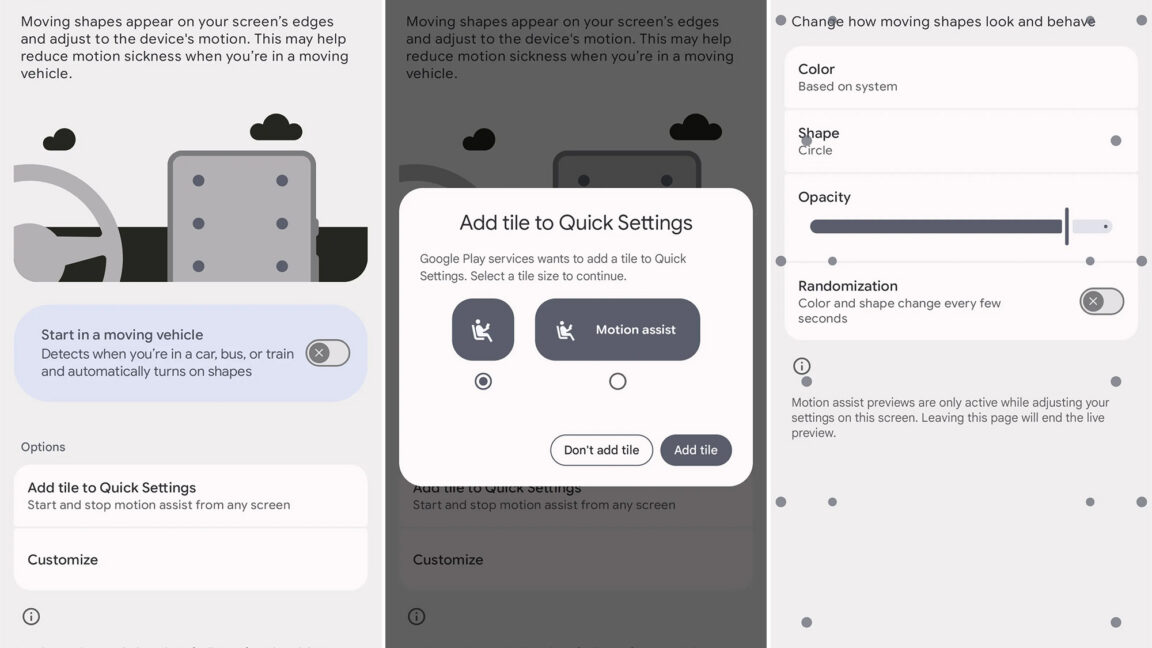
Google's new Motion Assist feature, designed to combat motion sickness, is now rolling out to Pixel phones running Android 17. The feature adds moving dots to the screen edges to synchronize with the device's motion, reducing sensory conflict.

Key Numbers

2024year Google began testing Motion Assist

Who's Involved

Google
rolling out anti-motion sickness feature
Apple
introduced similar feature on iPhone
Android Authority
reported on Motion Assist appearing on Pixel phones
Google rolls out anti-motion sickness feature on Android

↳ Why This Matters

This feature addresses a common discomfort for many smartphone users, potentially making mobile device usage more accessible and comfortable during travel.

Key facts

  • Google's Motion Assist feature aims to reduce motion sickness for smartphone users in moving vehicles.
  • The feature adds small, moving dots to the edges of the screen.
  • These dots synchronize with the phone's accelerometer and gyroscope to mimic real-world visual motion.
  • Motion Assist is rolling out to Pixel phones running Android 17 via Play Services.
  • Apple previously introduced a similar feature called Motion Cues on iPhones.

Google has begun a phased rollout of its Motion Assist feature for Android devices, designed to alleviate motion sickness experienced by users in moving vehicles. This feature aims to bridge the sensory gap between what the inner ear perceives and what the eyes see, a common cause of nausea when using a phone while traveling.

Motion Assist functions by displaying small, dynamic dots around the edges of the smartphone screen. These dots are synchronized with the phone's accelerometer and gyroscope, allowing them to move in accordance with the vehicle's motion. For instance, they will move down the screen when the vehicle is moving forward or to the left when turning right, simulating how objects would naturally appear to move in one's peripheral vision.

Apple introduced a comparable feature, Motion Cues, on its iPhones in 2024. Google had been testing its version, Motion Assist, internally since 2024, but it is now gradually becoming available to users. The feature is being delivered through Google Play Services and is currently appearing on Pixel phones running Android 17, with no specific app or manual update required for users to access it.

Frequently asked questions

Motion sickness is caused by a disagreement between what your inner ear senses and what your eyes see, particularly when looking at a stationary screen in a moving environment.

Motion Assist adds small dots around the edges of the screen that move in sync with the phone's motion sensors, mimicking how real-world objects would appear to move.

No, the feature is being delivered by Google Play Services as part of a staged rollout and does not require a separate app or manual update.

Currently, the feature is appearing on Pixel phones running Android 17, indicating a staged rollout.

What Happens Next

01Motion Assist will continue to roll out to more Android devices.
02Users can expect the feature to appear via Google Play Services.

How It Developed

Google began testing Motion Assist in 2024.
Motion Assist is now appearing on Pixel phones running Android 17.
The feature is being delivered via Play Services as part of a staged rollout.
Motion Assist adds small dots around the edges of the phone screen.
The dots move in concert with the vehicle's motion, mimicking real-world visual cues.

Sources

T1
Google begins rolling out anti-motion sickness feature on Android 17var abtest_2169021 = new ABTest(2169021, 'impression');Ars Technica

Related Stories

New bootloader grants full control over Meta Quest headsets
25 Aug · 4:11 PM
Uber rolls out live video streaming for teen accounts
25 Aug · 1:16 PM
Google Expands Gemini AI for Law Firms, Financial Services
25 Aug · 12:06 PM
AI is disproportionately impacting entry-level jobs, Stanford study finds
24 Aug · 9:51 PM
Waymo to begin autonomous vehicle testing in Munich
25 Aug · 2:56 PM