Key facts
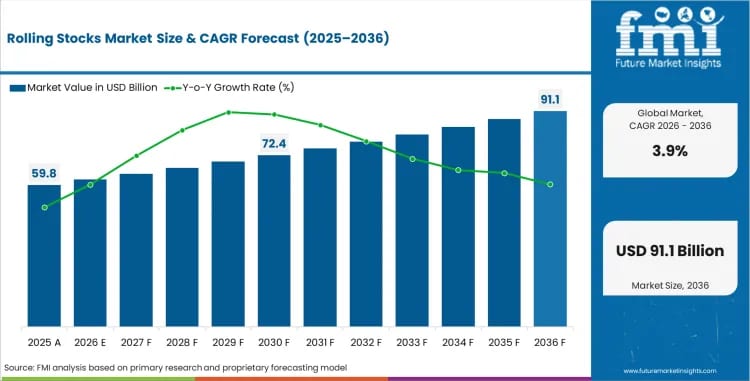
- The global rolling stock market is projected to reach $91.09 billion by 2036.
- The market is expected to grow at a 3.9% CAGR from 2026 to 2036.
- Locomotives are expected to lead with a 30.4% market share in 2026.
- Conventional technology is projected to hold a 63.2% share in 2026.
- China is expected to lead growth with a 5.3% CAGR through 2036.
- National railway modernization and urban mass transit expansion are driving demand.
The global rolling stock market is poised for significant expansion, with projections indicating a valuation of $91.09 billion by 2036, up from an estimated $59.80 billion in 2025 and $62.13 billion in 2026. This growth is underpinned by a compound annual growth rate of 3.9% anticipated between 2026 and 2036, representing an incremental opportunity of $28.96 billion over the forecast period.
Demand patterns are evolving, with a shift from standardized procurement cycles towards specification-driven purchasing. Buyers are increasingly prioritizing product performance certifications and supply chain traceability before approving orders, recalibrating supplier qualification criteria and contract renewal timelines across major consuming regions.
Locomotives are expected to dominate the market in 2026 with a 30.4% share, while conventional technology will hold a 63.2% share. Key growth drivers include national railway modernization programs in China, India, and Western Europe, as well as urban mass transit expansion projects in Asia Pacific, Latin America, and the Middle East. Freight rail operators are also investing in energy-efficient locomotives to meet decarbonization targets and rising fuel costs, favoring a modal shift from road to rail.
China is expected to lead market growth with a 5.3% CAGR through 2036, supported by its manufacturing infrastructure and government procurement. Other significant markets include India (4.9%), Germany (4.5%), France (4.1%), the UK (3.7%), the USA (3.3%), and Brazil (2.9%).