All NewsEducationTVBrokers
Equities & FundsCrypto & Digital AssetsAI & TechnologyBusiness & CorporateUS Politics & PolicyGeopolitics & Global RiskMacro, Rates & FXCommodities & EnergyEuropean Politics & MarketsAsia-PacificReal Estate & Property
All NewsHome
← Back to US Politics & Policy

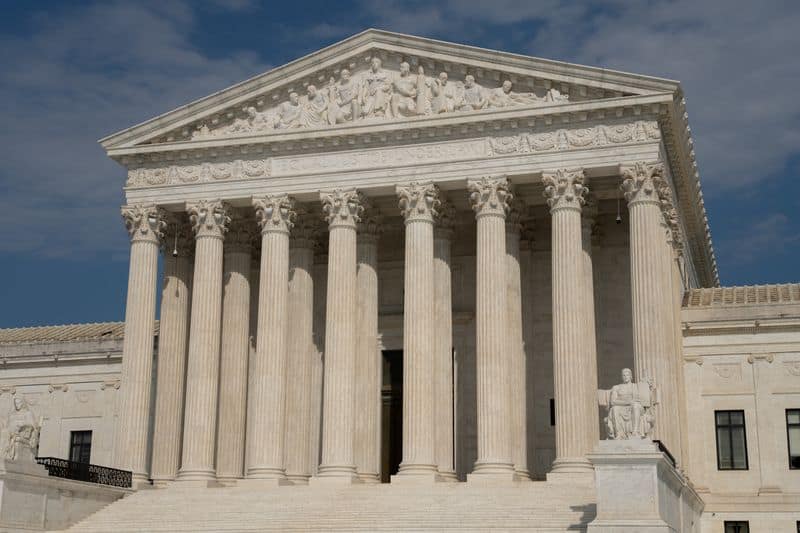
Democrats block Republican bid to cap Supreme Court at nine justices

Created at 2 Sep · 8:43 PM1 source↑ Market-relevant
IN SHORT

Democrats in the U.S. House of Representatives voted against a Republican proposal to permanently cap the Supreme Court at nine justices. The measure failed to achieve the necessary two-thirds majority, with Republicans aiming to make the court's conservative majority a campaign issue ahead of the November elections.

Key Numbers

nineSupreme Court justices cap proposed
212-206House vote tally on amendment
two-thirdsMajority needed to pass amendment
218Republican seats in House
214Democratic seats in House
38States needed to ratify amendment
1869Year Supreme Court size fixed at nine
1937Year of FDR's failed court-packing attempt
sixJustices FDR proposed adding
2021Year court overturned Roe v. Wade
13Justices Democrats propose adding

Who's Involved

Democrats
voted against Republican proposal to cap Supreme Court justices
Republicans
proposed constitutional amendment to cap Supreme Court justices
U.S. House of Representatives
voted on the proposed constitutional amendment
Mike Johnson
Republican Speaker who scheduled the vote
Jamie Raskin
Democratic Representative opposing the measure
Donald Trump
Republican President who appointed three justices
Franklin D. Roosevelt
Democratic President whose 1937 court-packing attempt failed
Andy Biggs
Republican Representative arguing against court expansion
Democrats block Republican bid to cap Supreme Court at nine justices

↳ Why This Matters

The failed vote underscores the deep partisan divisions over the Supreme Court's composition and the potential for significant institutional changes if election outcomes shift congressional control, impacting major legal and social issues.

Key facts

  • Democrats in the U.S. House of Representatives voted against a Republican proposal to permanently cap the Supreme Court at nine justices.
  • The Republican measure failed to pass, falling short of the required two-thirds majority.
  • Republicans aimed to use the vote to highlight the court's conservative majority and make it a campaign issue.
  • The U.S. Constitution does not establish the number of Supreme Court justices, which has fluctuated historically.
  • Democrats have previously proposed legislation to expand the court to 13 justices.

Democrats in the U.S. House of Representatives defeated a Republican-led constitutional amendment aimed at permanently capping the Supreme Court at nine justices. The vote, which failed 212-206, fell far short of the two-thirds majority required for passage. Republicans staged the vote to highlight the potential for Democrats to expand the court if they regain control of Congress in the upcoming November elections, thereby weakening its conservative majority.

Republicans argued that the amendment was necessary to prevent Democrats from altering the court's composition, particularly after President Donald Trump appointed three justices, establishing a 6-3 conservative majority. House Speaker Mike Johnson stated that Democrats' objective was to "pack the U.S. Supreme Court." Conversely, Democrats characterized the Republican effort as a "partisan power grab" and a tactic to shore up voter support amid concerns about inflation, war, and debt.

The U.S. Constitution does not specify the number of justices on the Supreme Court; its size has varied throughout history, with Congress setting it between five and ten justices. The court has maintained nine justices since 1869. A notable historical precedent is President Franklin D. Roosevelt's 1937 attempt to add six justices, which was widely criticized and decisively rejected by lawmakers.

Recent Supreme Court decisions since 2021, including the overturning of the nationwide right to abortion, expansion of gun rights, and curtailment of federal agency powers, have fueled Democratic calls for reform. Democrats have previously introduced legislation to increase the number of justices to 13.

Frequently asked questions

Republicans proposed a constitutional amendment to permanently cap the number of U.S. Supreme Court justices at nine.

Democrats opposed the measure, viewing it as a partisan attempt to prevent them from expanding the court and weakening its conservative majority if they gain control of Congress.

No, the U.S. Constitution does not specify the number of justices. The size has fluctuated historically, with Congress setting it between five and ten justices. It has been nine since 1869.

Court-packing refers to efforts to change the size of a court, typically to influence its ideological balance, as seen in President Franklin D. Roosevelt's failed attempt in 1937.

What Happens Next

01Democrats may pursue legislation to expand the Supreme Court to 13 justices.
02The composition of the Supreme Court will likely remain a key issue in the November elections.

How It Developed

Republicans proposed a constitutional amendment to cap the Supreme Court at nine justices.
Democrats staged a vote to highlight potential court expansion if they regain control of Congress.
The measure failed in the House of Representatives with a vote of 212-206.
Republicans control 218 seats in the House, Democrats hold 214.
The proposed amendment faced long odds in the Senate and ratification by states.
Republicans argued the amendment was necessary to prevent Democratic court-packing efforts.
Democrats opposed the measure, calling it a partisan power grab.
The U.S. Constitution does not specify the number of Supreme Court justices.

Sources

T1
Democrats sink Republican bid to cement US Supreme Court's conservative majorityReuters

Related Stories

US judge blocks Trump's newest order limiting birthright citizenship
2 Sep · 9:42 PM
Nicaragua Congress passes reform barring opposition from elections
2 Sep · 12:11 AM
Fed Chair Warsh faces credibility test on inflation, interest rates
2 Sep · 10:06 AM
Vulnerable Democrats vote to denounce socialism amid midterm pressure
1 Sep · 11:31 PM
House panel to examine birthright citizenship after Supreme Court ruling
2 Sep · 5:51 PM