Key facts
- DexForce uses virtual data to train humanoid robots, aiming for cost reduction and efficiency.
- The company's approach is compared to the breakthrough generative AI saw with ChatGPT.
- DexForce raised 1 billion yuan ($147 million) in a Series B funding round.
- The startup is backed by Lenovo Capital, Lens Technology, and several state-owned funds.
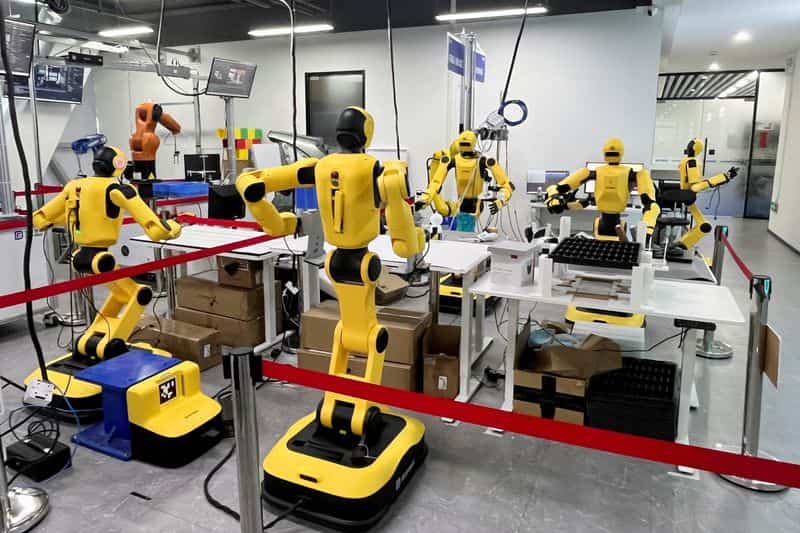
Chinese startup DexForce is developing AI software to train humanoid robots using synthetic data generated in virtual environments, aiming to reduce costs and improve efficiency compared to traditional real-world data collection methods. The company believes this approach can accelerate breakthroughs in robot capabilities, drawing parallels to the impact of ChatGPT on generative AI. DexForce's CEO, Jia Kui, stated that achieving 'physical artificial general intelligence' solely through real-world data would require an impractical number of samples. The company's software simulates physical environments and predicts object interactions, enabling robots to be trained virtually before deployment. This process is reportedly faster and cheaper than human-led training, which can involve repeating movements over a hundred times. While many Chinese robot makers use a combination of simulated and real-world data, DexForce's reliance on synthetic data is a key differentiator. Founded in 2021 by Jia Kui, a machine-learning professor, the Shenzhen-based startup has approximately 500 employees and has secured 1 billion yuan ($147 million) in Series B funding, valuing the company at over 10 billion yuan. Its software is utilized by global manufacturers such as Toyota, Samsung, Panasonic, Foxconn, Haier, and Hisense. Additionally, DexForce's humanoid robots are deployed in over 15 cities nationwide, serving coffee and customers in commercial settings.