Key facts
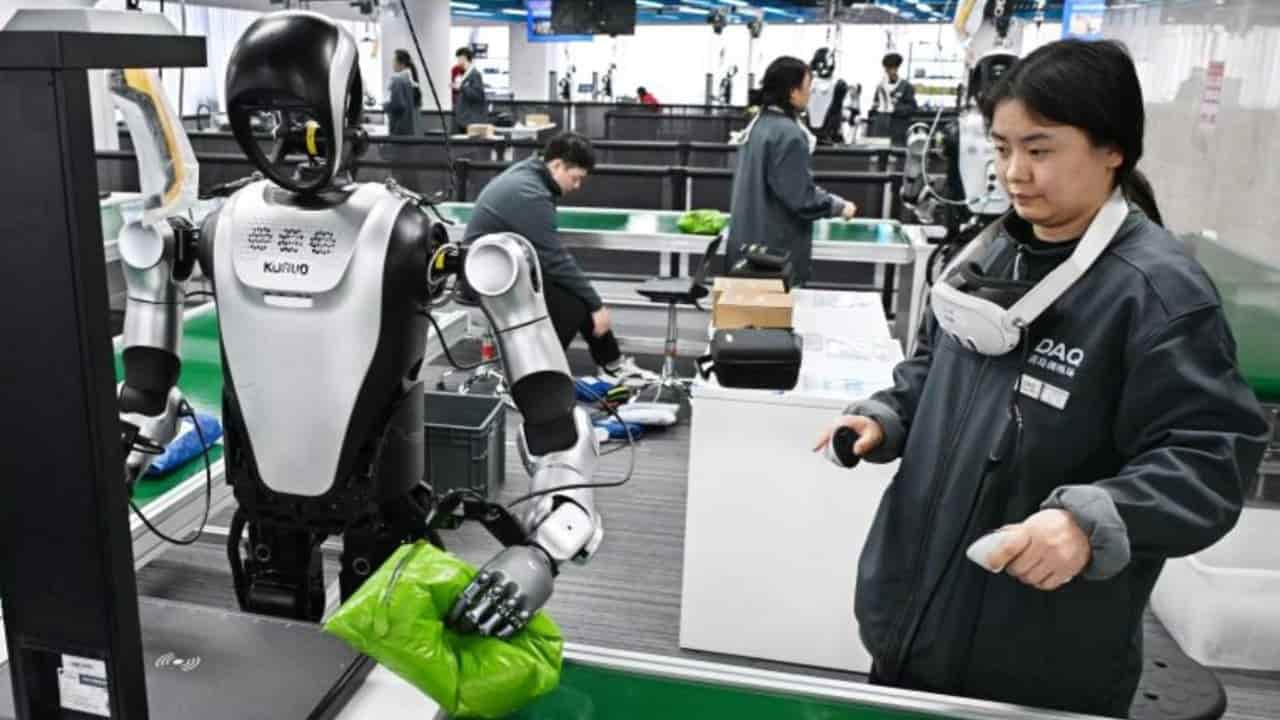
- Human trainers in China are using motion-capture gear to perform tasks like folding clothes and washing dishes to generate data for training humanoid robots.
- These robots are being trained for applications in kitchens, factories, and supermarkets.
- The training centers, described as "robot schools," emphasize high repetition of physical tasks to build robust manipulation skills.
- China is the world leader in humanoid robot production, accounting for over 97% of global shipments in the first half of 2026.
- The Shijingshan Humanoid Robot Data Training Centre in Beijing is China's largest, covering over 10,000 sq m and is developing a virtual simulation system.
- Trainers are reportedly paid between 4,000 yuan and 6,000 yuan (up to US$900) per month for these roles.
China is establishing large-scale training centers, referred to as "robot schools," where human trainers perform repetitive physical tasks to generate data for teaching humanoid robots. These centers are crucial for advancing China's embodied intelligence industry, a key focus in its national development plans.
The training involves human data trainers wearing motion-capture gear to perform actions like folding clothes, washing dishes, picking up objects, and scanning items. This data is then converted into training sets to enable robots to operate in diverse environments, including homes, factories, and supermarkets.
The Shijingshan Humanoid Robot Data Training Centre in Beijing, operational since September 2025, is a significant facility covering over 10,000 square meters. It is jointly operated by Jing Shi Science and Technology Innovation Group and Leju (Shenzhen) Robotics. The center aims to provide data training for robots in home services, daily life, and industrial manufacturing scenarios, and is developing a virtual simulation system to accelerate data generation.
This initiative is part of a national strategic push, with embodied intelligence identified as a key future industry in China's 15th Five-Year Plan and government work reports. China has emerged as a global leader in humanoid robot production, accounting for more than 97% of global shipments in the first half of 2026. The country's extensive manufacturing capabilities are being complemented by these training centers to ensure robots can perform effectively in real-world settings, thereby securing orders and driving commercial viability.
Beyond Beijing, similar large-scale training bases are emerging across China, with provinces like Zhejiang, Guangdong, and Jiangsu housing numerous centers. Shandong province has also prioritized 26 embodied intelligence robot training facilities. These centers are designed to train robots on tasks such as folding laundry, ironing, retrieving items from shelves, and wiping tables, with a particular focus on complex manipulation skills required for deformable objects like clothing.