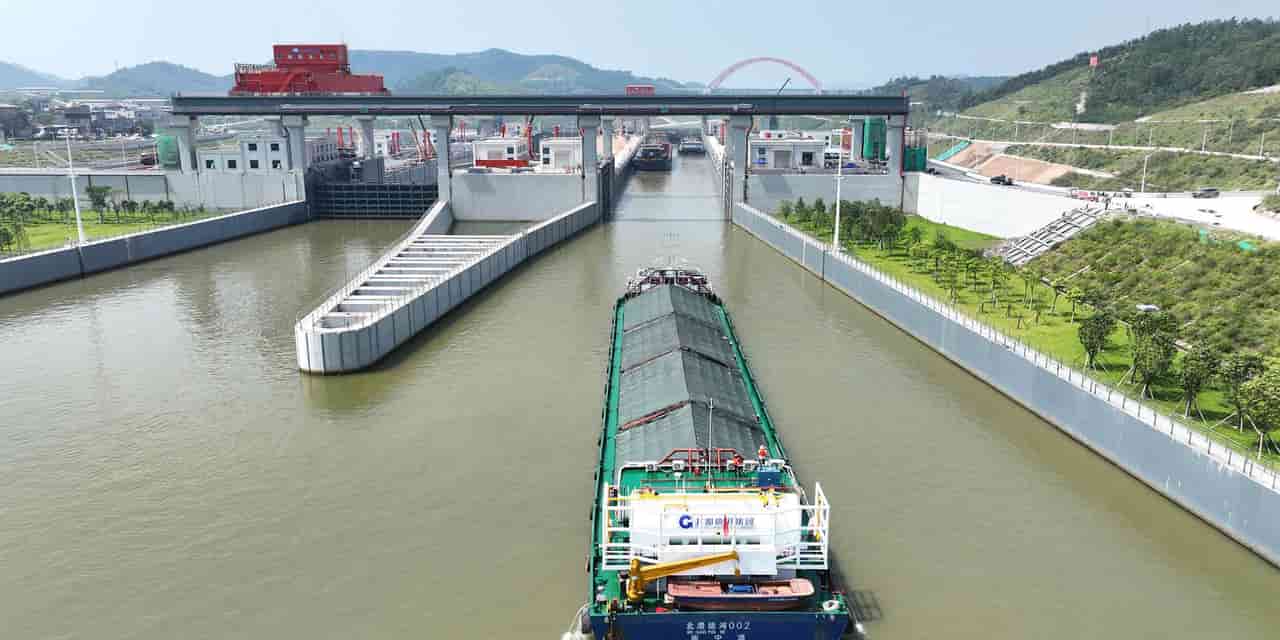
Key facts
- The Pinglu Canal is 134 kilometers long and connects the Xijiang River to the Beibu Gulf.
- Construction of the canal began in 2022 and involved three giant locks.
- The canal shortens the route from inland Guangxi to the sea by over 500 kilometers.
- Logistics costs for transport between Guangxi and Southeast Asia are expected to decrease by up to 30%.
- The estimated construction cost of the canal is approximately RMB 72 billion (€9.5 billion).
- The canal is part of the 'New International Land-Sea Trade Corridor' and the 'Belt and Road' Initiative.
The Pinglu Canal, a 134-kilometer waterway in China's Guangxi Zhuang Autonomous Region, was inaugurated on September 16, aiming to boost trade and industrial development in southwestern China and strengthen ties with Southeast Asian nations.
The canal connects the Xijiang River to the Beibu Gulf, significantly shortening shipping routes and reducing logistics costs by an estimated 30% for trade between Guangxi and ASEAN countries. This infrastructure project, which began construction in 2022 and cost approximately RMB 72 billion (€9.5 billion), features three large locks capable of handling 5,000-tonne vessels.
For Guangxi, which has historically lagged behind other coastal provinces in development, the canal is expected to improve connectivity and support its growing green energy and electric vehicle sectors. The region is leveraging its proximity to Southeast Asia, hosting the annual China-ASEAN Expo and attracting foreign investment, including from Malaysia in the China-Malaysia Qinzhou Industrial Park.
The Pinglu Canal is integrated into the 'New International Land-Sea Trade Corridor,' a broader initiative launched in 2019 to open up western Chinese provinces, and is also part of the 'Belt and Road' Initiative. The Beibu Port, already a significant hub for trade with Southeast Asia, is expected to see further growth and new maritime routes as a result of the canal's opening.
The project aligns with closer China-ASEAN relations, with China being ASEAN's largest trading partner. The modernization of their free trade agreement (CAFTA 3.0) and geopolitical tensions, including the Sino-American trade war, are prompting Chinese companies to increase their investment in Southeast Asian nations like Vietnam and Malaysia.