Key facts
- China's gig economy was valued at 3.4 trillion yuan by 2020.
- Over 200 million workers are in China's gig economy.
- Gig workers lack health insurance, unemployment insurance, and retirement savings.
- The food delivery sector is a major driver, reaching 1.5 trillion yuan by 2023.
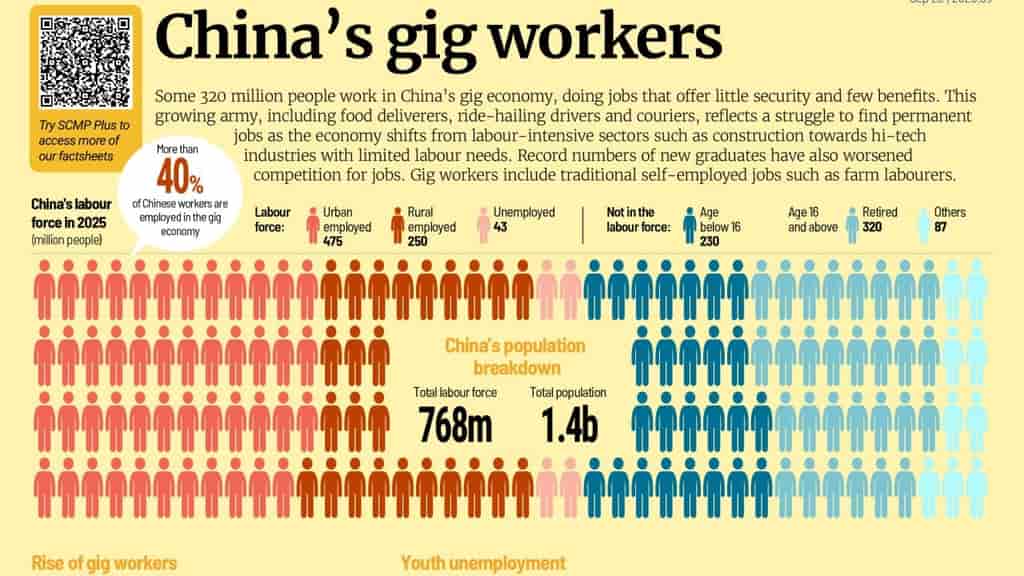
- The gig economy is projected to account for 40% of total employment by 2025.
China's gig economy has rapidly expanded, reaching a value of 3.4 trillion yuan by 2020 and employing over 200 million workers, approximately 25% of the national workforce. This growth is attributed to digitalization, urban migration, and state policies like Premier Li Keqiang's 'Internet Plus' strategy introduced in 2015. The food delivery sector has been a significant driver, doubling to 1.5 trillion yuan by 2023. The gig economy is projected to constitute 40% of total employment by 2025.
The evolution of this sector began in the 1980s with Deng Xiaoping's economic reforms, gaining momentum in the early 2000s due to urban migration and layoffs from state-owned enterprises. Capital constraints in the 2010s further fueled the trend by fostering flexibility for businesses and workers. A 2016 collaboration between the World Bank and Alibaba Group focused on leveraging digital technologies, particularly e-commerce, to drive rural growth and employment, contributing to poverty alleviation for millions.
However, the surge in gig work, partly driven by a weak labor market and over 10 million annual graduate entries, has led to lower wages and increased financial insecurity for workers. Classified as independent contractors, these individuals lack essential social safety nets such as health insurance, unemployment insurance, and retirement savings. China's rigid welfare system and the informal operations of third-party labor companies exacerbate these vulnerabilities.