All NewsEducationTVBrokers
Equities & FundsCrypto & Digital AssetsAI & TechnologyBusiness & CorporateUS Politics & PolicyGeopolitics & Global RiskMacro, Rates & FXCommodities & EnergyEuropean Politics & MarketsAsia-PacificReal Estate & Property
All NewsHome
← Back to Commodities & Energy

Canada's Trans Mountain Pipeline Reaches Full Capacity, Eyes Asia

Created at 8 Sep · 5:21 PM1 source↑ Market-relevant
IN SHORT

Canada's Trans Mountain pipeline has reached full capacity for the first time, with plans to expand further. A significant portion of its exports are now heading to Asia, driven by refinery configurations and geopolitical tensions in the Middle East.

Key Numbers

890,000 bpdcurrent Trans Mountain pipeline capacity
300,000 bpdadditional planned capacity
90,000 bpdcapacity increase in Q4
210,000 bpdcapacity increase by end of 2028
1.19 million bpdtotal planned capacity
two-thirdsof tankers heading to Asia
5.3 million bpdrecord Canadian oil output last year
4 million bpdCanadian oil shipped to the US
300,000 bpdproduction reduction from maintenance

Who's Involved

Trans Mountain
pipeline operator planning expansion
Mark Maki
CEO of Trans Mountain
Vitol
CEO commenting on tight fuel markets
Canada's Trans Mountain Pipeline Reaches Full Capacity, Eyes Asia

↳ Why This Matters

The expansion and increased utilization of the Trans Mountain pipeline signify a strategic diversification of Canada's oil exports away from the U.S. market towards Asia, driven by infrastructure development, Asian refinery demand, and geopolitical risks in key shipping lanes.

Key facts

  • The Trans Mountain pipeline reached its full capacity of 890,000 barrels per day in June.
  • Planned expansions will increase total capacity to approximately 1.19 million barrels per day by the end of 2028.
  • About two-thirds of tankers departing the Westridge Marine Terminal are destined for Asia.
  • China is the primary customer, with India, Japan, South Korea, and Vietnam increasing their purchases.
  • Canada is projected to be the world's fourth-largest oil producer this year, exceeding last year's record output.

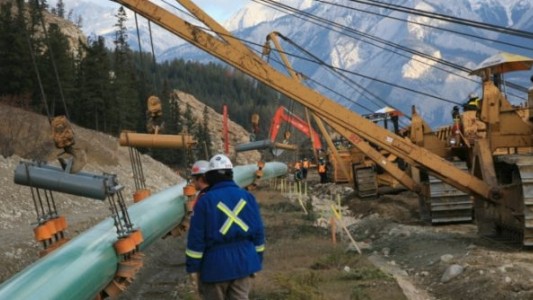
Canada's Trans Mountain pipeline has achieved full operational capacity for the first time, signaling a significant shift in the nation's oil export strategy towards Asian markets. The pipeline, which currently moves 890,000 barrels per day (bpd) from Alberta to British Columbia, is undergoing expansions that will boost its total capacity to approximately 1.19 million bpd by the end of 2028.

Trans Mountain CEO Mark Maki stated that roughly two-thirds of the tankers leaving the Westridge Marine Terminal are now bound for Asia. China stands as the largest customer, with India, Japan, South Korea, and Vietnam anticipated to increase their purchases of Canadian crude. The suitability of Canadian heavy crude for the complex refineries prevalent across Asia, coupled with geopolitical considerations such as avoiding the Strait of Hormuz amid Middle East tensions, are driving this pivot.

Canada's oil production is robust, with output this year expected to surpass last year's record of 5.3 million bpd, positioning the country as the world's fourth-largest producer. While the United States remains a primary destination for Canadian crude, the expanded Trans Mountain capacity opens avenues for additional international buyers. Despite an anticipated temporary reduction in production due to oil sands maintenance in September and currently low inventories, the increased Pacific export capacity provides producers with greater market access as barrels return.

This development follows Canada's announcement in July of plans for another Alberta-to-Pacific pipeline, with the Trans Mountain expansion offering a more immediate solution for increased export capacity.

Frequently asked questions

The Trans Mountain pipeline currently moves 890,000 barrels per day (bpd) from Alberta to British Columbia.

The operator plans to add 90,000 bpd in the fourth quarter and an additional 210,000 bpd by the end of 2028, bringing total capacity to approximately 1.19 million bpd.

China is the largest customer, with India, Japan, South Korea, and Vietnam expected to buy more Canadian crude. Thailand could also join this list.

Canadian heavy crude works well in the complex refineries common across Asia.

What Happens Next

01Trans Mountain plans to add 90,000 bpd of capacity in the fourth quarter.
02An additional 210,000 bpd of capacity is expected by the end of 2028.
03Thailand may become a new customer for Canadian crude.
04Canadian oil sands maintenance is expected to remove 300,000 bpd of production in September.
CME Headlines
  • Crude oil hits eight-week high.
    8 Sep · 3:17 PM
  • Crude oil hits eight-week high.
    8 Sep · 3:17 PM
  • Crude oil hits eight-week high.
    8 Sep · 3:17 PM

How It Developed

Trans Mountain pipeline reached full capacity in June.
Operator plans to add 90,000 bpd capacity in Q4.
Further expansion to add 210,000 bpd by end of 2028.
Two-thirds of tankers from Westridge Marine Terminal currently head to Asia.
China is the largest customer, with India, Japan, South Korea, and Vietnam expected to increase purchases.
Canadian heavy crude is suitable for Asian refineries.
Avoiding the Strait of Hormuz is a geopolitical advantage.
Canada's oil output is expected to exceed 5.3 million bpd this year.

Sources

T1
Canada’s Oil Pivot to Asia Is Starting to MaterializeOilPrice.com

Related Stories

Rosneft Ships First Crude From $157 Billion Vostok Oil Project
8 Sep · 1:56 AM
$100 Brent Looms as China’s Oil Buying Rebounds
8 Sep · 4:31 PM
China Crude Imports Rise 6.2% in August on Fuel Export Demand
8 Sep · 10:31 AM
Gulf Producers Reroute Oil Exports Amid Hormuz Tensions
8 Sep · 12:20 PM
Suez Canal Traffic Surges Amid Red Sea Shipping Threats
8 Sep · 1:21 PM