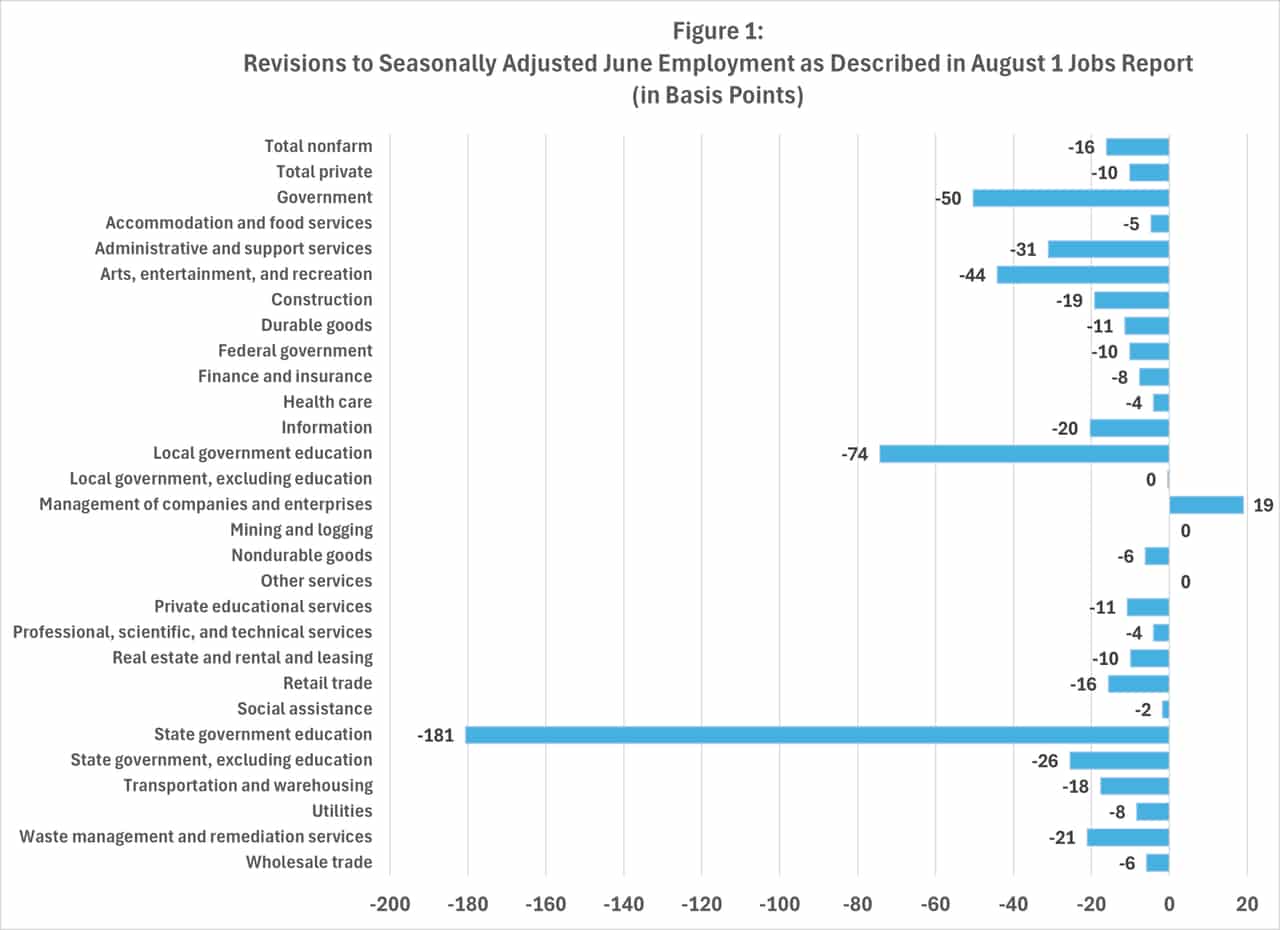
The Bureau of Labor Statistics' 2026 revisions to employment figures indicate a minor downward adjustment of 0.1% of the total workforce. This smaller revision suggests increased accuracy in the jobs numbers, contrasting with larger historical adjustments.

These revisions are crucial for understanding the true state of the labor market, influencing economic forecasts, monetary policy decisions by the Federal Reserve, and business investment strategies.
The Bureau of Labor Statistics (BLS) has implemented its 2026 revisions to employment figures, revealing a modest downward adjustment of 0.1% of the total workforce. This revision is notably smaller than many historical adjustments, suggesting a potential increase in the accuracy of current jobs numbers.
Analysis from Edgeworth Economics highlights that while the overall revision to total employment was the largest in two decades (excluding a COVID-era adjustment in spring 2020), the revision to private sector employment was smaller, at one-tenth of one percent. Government employment, particularly within educational institutions, accounted for a significant portion of the total revision. Local government education saw a revision more than seven times larger than private sector employment, and state government education saw a revision over 17 times larger.
Edgeworth Economics anticipates that future substantial revisions may occur. This expectation is based on recent historical patterns and a decline in the establishment survey's response rate, which has fallen below 43%. A projected benchmark revision to payroll employment is scheduled for September 9th, which could lead to further changes in employment estimates by several hundred thousand employees.
The Current Employment Statistics (CES) establishment survey, which provides the data for the jobs report, surveys approximately 650,000 establishments monthly out of over 12 million in the U.S. Revisions are made in subsequent reports due to late submissions from some establishments and the recalculation of seasonal factors. The BLS reports a standard error of about 83,000 employees for the estimated month-to-month change in total non-farm payroll employment.