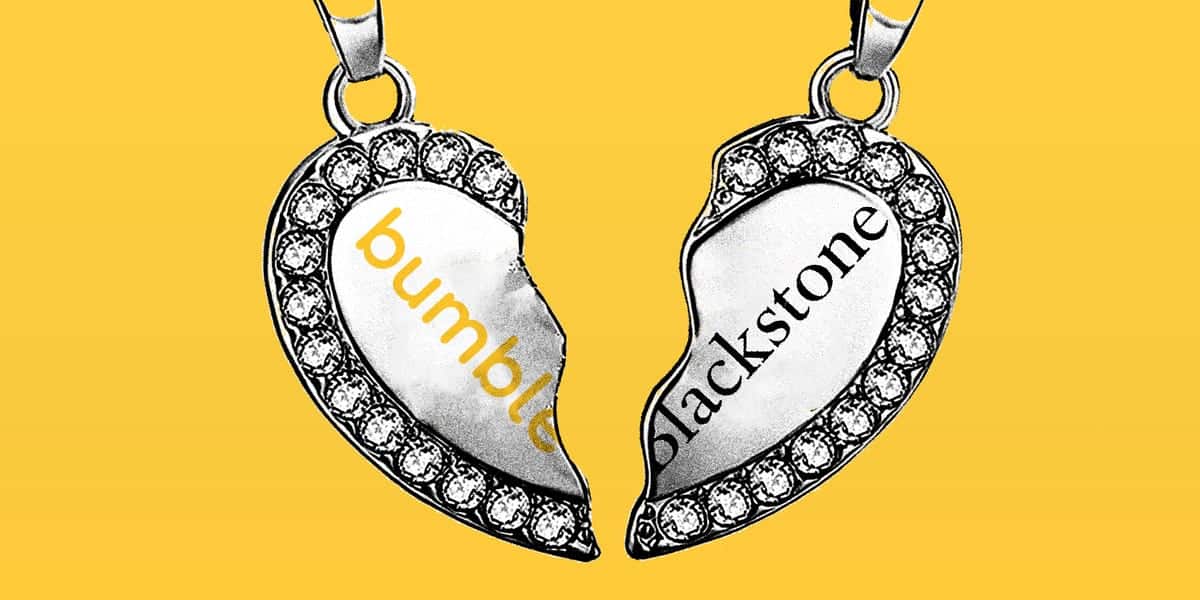
Key facts
- Blackstone is poised to exit its investment in Bumble, having doubled its initial capital.
- Blackstone first invested in Bumble's parent company, MagicLab, in 2019.
- Bumble's market value has fallen to less than $450 million from a peak of roughly $13 billion post-IPO.
- Blackstone is selling its remaining shares through a deal with UBS, aiming for a full exit in the first half of next year.
- Blackstone received a $334 million dividend in late 2020 and sold over $3 billion in shares in multiple tranches.
- Jonathan Korngold and Martin Brand, formerly associated with Blackstone's Bumble deal, have stepped down from Bumble's board.
Blackstone is preparing to divest its remaining stake in the dating app Bumble, a move that will allow the private-equity firm to realize a significant profit on its initial investment despite the app's substantial stock market decline. Blackstone first acquired a majority stake in Bumble's parent company, MagicLab, in 2019 for $3 billion. Following Bumble's initial public offering (IPO) a year later, its valuation soared to approximately $13 billion. However, the dating app's shares have since plummeted by over 96% from their peak, reducing its market capitalization to below $450 million.
According to SEC filings, Blackstone entered into an agreement with UBS late last year that facilitates the sale of its Bumble holdings. This arrangement is expected to conclude with Blackstone exiting its position in the first half of next year. While investors who purchased shares on Bumble's IPO day have not seen their investments reach those initial highs, Blackstone is anticipated to have recouped roughly double the $2.1 billion it and venture capital firm Accel invested in 2019. The key to Blackstone's success was its strategy of cashing out early, beginning before Bumble's public market debut and continuing with substantial stock sales later that year.
Blackstone's exit strategy involved taking money off the table early. In late 2020, the firm utilized Bumble's debt to pay itself a $334 million dividend. During the IPO a few months later, Blackstone reduced its ownership from 83.6% to 53.2%, generating nearly $2 billion. In 2021, when Bumble's shares traded above $50, the firm sold an additional $1 billion in stock. However, Bumble's stock price began to decline, falling to less than $14 per share by the end of 2023.
Bumble has faced several challenges, including increased competition from Match Group's Hinge and a general trend of dating app fatigue. In 2024, Wolfe Herd stepped down as CEO, with new leadership brought in. She later announced her return as CEO with a focus on revamping Bumble's reputation and embracing AI. Blackstone's current holdings of 22.4 million shares are valued at just over $60 million, a stark contrast to the $1.084 billion generated from selling a similar number of shares in the second half of 2021.
Blackstone's exit process accelerated at the end of last year, starting with a $104 million sale in August 2025 that offloaded over 10% of its stake. The November agreement with UBS allows for quarterly sales of nearly 5% of the company. If this trend continues, Blackstone could be fully divested by early next year. Further signaling its departure, Blackstone's board representation on Bumble has decreased from two seats to none. Jonathan Korngold, former head of Blackstone Growth, stepped down from the board on June 30, coinciding with his exit from Blackstone. Martin Brand also departed Bumble's board on August 10, though he remains with Blackstone as head of Capital Partners. Reuters reported in June that Bumble was exploring a potential sale process with Morgan Stanley, a move that Chandler Willison, a research analyst at M Science, suggested could be compelling for a private equity buyer seeking to improve performance.