Key facts
- Apple's new Macs are designed to handle intensive AI tasks locally, avoiding per-token fees from cloud AI providers.
- The company claims its machines offer significant value and performance for AI work without ongoing token costs.
- Apple's unified memory architecture, introduced in 2020, contributes to the Macs' AI capabilities.
- Four Mac Studios can be linked to run AI models with up to a trillion parameters, a task typically requiring a data center.
- Microsoft is developing on-device AI features for Windows, aiming for "unmetered intelligence."
- Apple holds approximately 4.6% of the enterprise desktop market, compared to Windows' 91.3%.
Apple is challenging the dominance of cloud-based AI computing and traditional data centers by promoting its new Mac Minis and Mac Studios as cost-effective solutions for businesses. The company argues that purchasing these machines offers a fixed cost for AI tasks, eliminating the variable per-token fees charged by cloud providers like OpenAI and Anthropic. This strategy directly targets Microsoft's stronghold in the enterprise desktop market and Nvidia's dominance in data center AI hardware.
When the upgraded Macs begin shipping on Tuesday, Apple executives will highlight their ability to handle intensive AI workloads, such as code writing and complex business operations, locally. This approach leverages Apple's long-standing expertise in optimizing performance and power efficiency in its devices, stemming from its unified memory architecture introduced with its first Apple Silicon chips in 2020. This architecture, which closely integrates computing and memory, has proven beneficial for AI tasks.
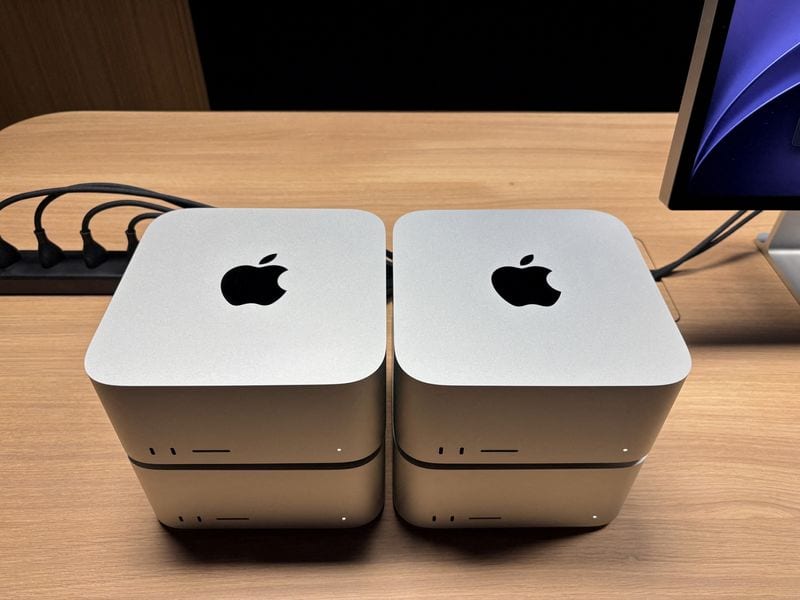
Apple has observed increased demand for Mac Minis, partly due to the popularity of open-source AI tools like OpenClaw. The company has also quietly integrated advanced AI features into Mac Studios, including RDMA over Thunderbolt, allowing for high-speed chip-to-chip networking. During a recent launch event, Apple demonstrated four Mac Studios linked together to process an AI model with a trillion parameters, a feat typically requiring significant data center infrastructure, but achieved by the Mac cluster using a single wall outlet.
Johny Srouji, Apple's chief hardware officer, emphasized the value proposition, stating, "Once you have the machine on your desk, you've paid for it. And I believe we provide absolutely great value, not only in terms of performance, but cost. There's no cost per token. You're just using the machine again and again."
Microsoft, meanwhile, is pursuing a similar strategy with its own on-device AI initiatives, which CEO Satya Nadella refers to as "unmetered intelligence." Microsoft plans to integrate many of these AI features into a "super app" for Windows. However, Microsoft's broad hardware support across various vendors can present challenges for developers optimizing for specific chips.
Microsoft stated it is collaborating with chip partners to enhance AI workflows through its Windows ML tools, with RDMA being an area of active investment. Nvidia, while declining to comment directly on competition with Apple's Macs, has indicated its focus is on expanding the capabilities of Windows PCs. Nvidia's primary strength remains in data center GPUs. Srouji noted that Apple's consistent chip design principles allow AI models developed on its devices to scale across its product line, from iPhones to high-end Mac Studios.