Key facts
- Asian markets traded mixed as AI-related shares declined, impacting benchmarks in Japan and South Korea.
- Geopolitical tensions between the U.S. and Iran escalated, contributing to market uncertainty.
- Oil prices saw gains, though remained near pre-conflict levels.
- Taiwan's Taiex recovered some losses, while Hong Kong and Australia's markets advanced.
- Concerns over AI valuations and rising costs influenced investor sentiment.
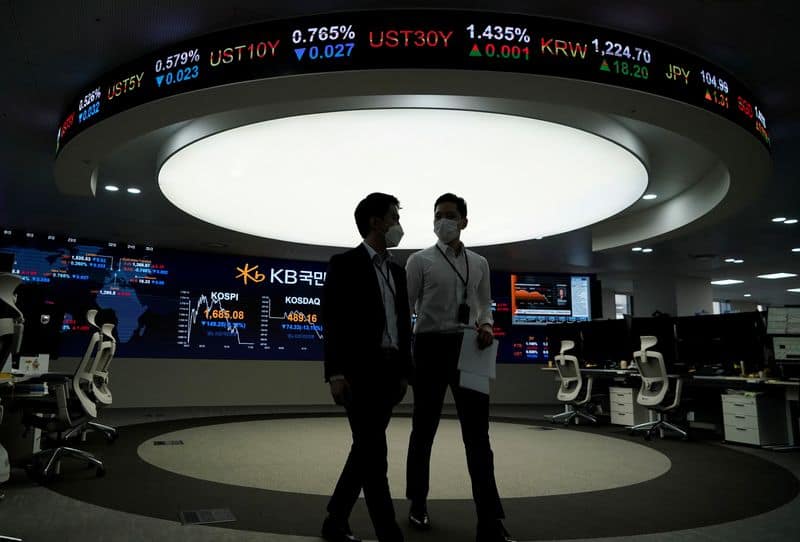
Asian markets traded mixed on Monday as investors grappled with concerns over artificial intelligence-driven growth, rising costs, and escalating geopolitical tensions in the Middle East. Selling pressure on AI-related shares dragged down benchmarks in Japan and South Korea.
Tokyo's Nikkei 225 fell 1%, with SoftBank Group, a significant investor in AI, dropping 5.9%. South Korea's Kospi lost 2%, impacted by declines in Samsung Electronics and SK Hynix. In contrast, Taiwan's Taiex gained 1.1%, recovering some of its previous losses, benefiting from its strong tech sector including chipmaker TSMC.
U.S. futures showed advances, and oil prices rose, though they remained near levels seen before the recent escalation of conflict. Tensions between the U.S. and Iran intensified over the weekend following new U.S. airstrikes and Iranian retaliatory attacks, adding to global economic uncertainties.
Brent crude was up 0.7% to $73.27 a barrel, and benchmark U.S. crude gained 0.8% to $70.02 a barrel. ING commodities strategists warned of significant upside risk to oil prices if supply recovery in the Persian Gulf proves slow or if tensions escalate further.
In currency trading, the U.S. dollar strengthened to 161.81 Japanese yen, while the euro held steady at $1.1386. Hong Kong's Hang Seng index rose 2.1%, and the Shanghai Composite edged up 0.2%. Australia's S&P/ASX 200 advanced 0.4%, while India's Sensex remained largely unchanged.