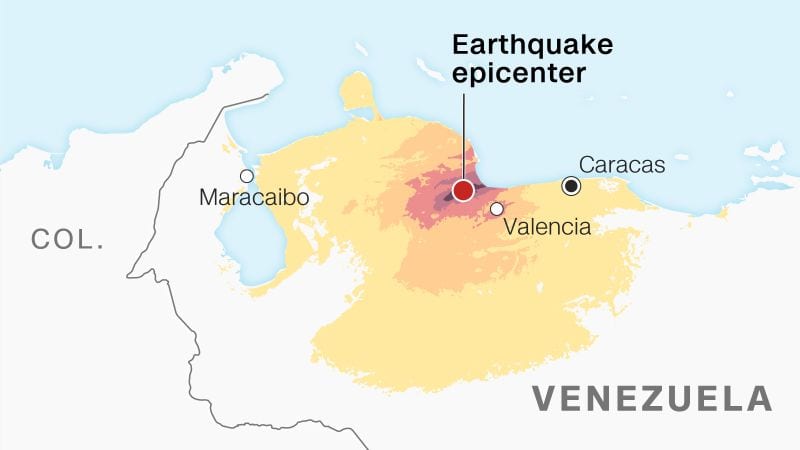
Key facts
- Two major earthquakes, magnitudes 7.2 and 7.5, struck Venezuela on June 24.
- At least 2,295 people have been killed.
- The coastal state of La Guaira is a designated disaster zone.
- Twenty-nine percent of buildings in La Guaira are estimated to be damaged.
- The earthquakes were a rare "doublet" phenomenon, with a foreshock followed by a larger quake.
- Satellite imagery shows widespread destruction, including collapsed buildings.
Two major earthquakes struck Venezuela on Wednesday, June 24, resulting in a significant loss of life and widespread destruction. The larger of the two quakes registered a magnitude of 7.5, preceded just 39 seconds earlier by a 7.2 magnitude foreshock. This rare "doublet" phenomenon, where two quakes of similar magnitude occur in rapid succession, is believed to have exacerbated the damage.
Venezuelan authorities have reported at least 2,295 fatalities. The coastal state of La Guaira has been declared a disaster zone, with an analysis by Oregon State University indicating that 29% of its buildings sustained damage, particularly in coastal areas. Satellite imagery from the affected region shows the extent of the devastation, with numerous structures collapsed or severely compromised.
Experts and citizens alike fear that the actual death toll may be considerably higher, with the U.S. Geological Survey suggesting a high probability of tens of thousands of casualties. Large-scale rescue operations are currently underway in La Guaira, focusing on searching for survivors trapped beneath the rubble of collapsed buildings.
The region is inherently vulnerable to seismic activity due to its location near the boundaries of several tectonic plates. The recent earthquakes, the largest recorded in Venezuela in over a century, have been followed by at least nine aftershocks exceeding magnitude 4.0, though these have not caused further significant damage as the tectonic plates settle.