Key facts
- UN Secretary-General António Guterres called for an immediate end to fighting across the Middle East.
- He warned that the conflict is a significant driver of global instability.
- Disruptions include collapsed trade through the Strait of Hormuz, upended energy markets, and surging food and fertilizer prices.
- The conflict threatens 45 million people with acute food insecurity and could push millions more into poverty.
- Guterres welcomed an agreement for Hamas to disarm and Israel to withdraw from Gaza, urging its full implementation.
UN Secretary-General António Guterres has declared that fighting across the Middle East must cease, warning that the escalating conflict is increasingly becoming a driver of global instability. He noted that trade through the Strait of Hormuz has collapsed, energy markets have been upended, and prices of food and key fertilizers have surged, causing supply chains to buckle.
The World Food Programme has warned that as many as 45 million people could face acute food insecurity as a result, with rising prices and slowing growth threatening to push millions more back into poverty.
Guterres welcomed an announcement regarding an agreement for Hamas to relinquish its weapons and for Israel to withdraw its forces from Gaza, calling it 'good news.' He stressed that the roadmap for these objectives must be followed without question or skepticism, emphasizing that now is the time for both sides to implement what was agreed.
Violence and civilian casualties are rising across the region, with UN agencies reporting increased hostilities in Gaza, Lebanon, and the West Bank. Since March 2, at least 4,329 deaths and 12,233 injuries have been recorded in southern Lebanon. Over the past five months, more than 4,000 children have reportedly been killed or injured across six countries, including 386 killed and 2,117 injured in Iran amid ongoing US bombing. In Gaza, Israel has killed 1,180 Palestinians and injured 3,810 others between a ceasefire in October 2025 and July 22, 2026. In the occupied West Bank, Israeli attacks have killed 1,122 Palestinians, at least 246 of them children, between October 2023 and July 24, 2026.
UNICEF's acting director for the Middle East and North Africa, Abdul Fofana, highlighted that children continue to pay the heaviest price, with a recent incident on Qeshm Island reportedly killing a two-year-old child and their parents. He reiterated calls for all parties to comply with international humanitarian law and for ceasefires to be respected.
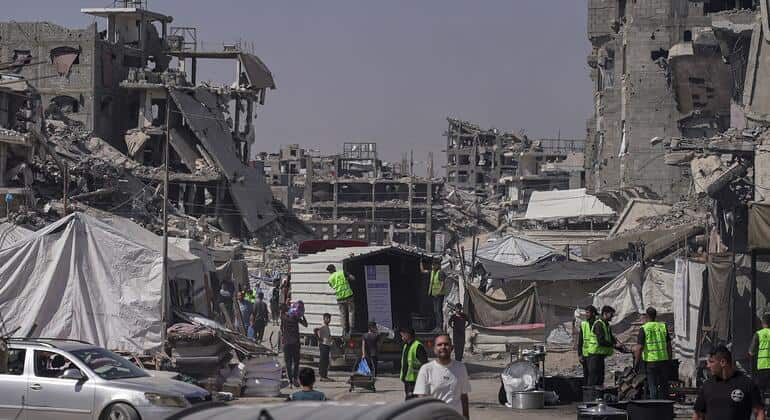
In Gaza, Israeli airstrikes and gunfire have intensified, and restrictions on fuel, engine oil, and spare parts have impacted UNRWA's operations, affecting its fleet and water wells. Guterres, speaking after a visit to the region, stated that the region and the world cannot afford more war and that an 'off-ramp' is desperately needed, with de-escalation and dialogue being the only way forward. He also noted that military spending is skyrocketing while lifesaving aid is in freefall.