Key facts
- Tucker Carlson interviewed Russian arms dealer Viktor Bout, who was previously condemned by Carlson.
- Bout promoted Russian narratives on the Ukraine war, claiming Ukraine is a pawn of Western 'handlers'.
- Bout suggested countries manufacturing weapons for Ukraine could become legitimate military targets.
- The interview touched on historical revisionism, with Bout downplaying Russia's role in the conflict.
- Carlson and Bout discussed Ukraine's alleged ties to Israel and arms sales to groups like Hezbollah and Hamas.
- Bout accused Ukrainian forces of terrorizing civilians, a claim that mirrors documented Russian war crimes.
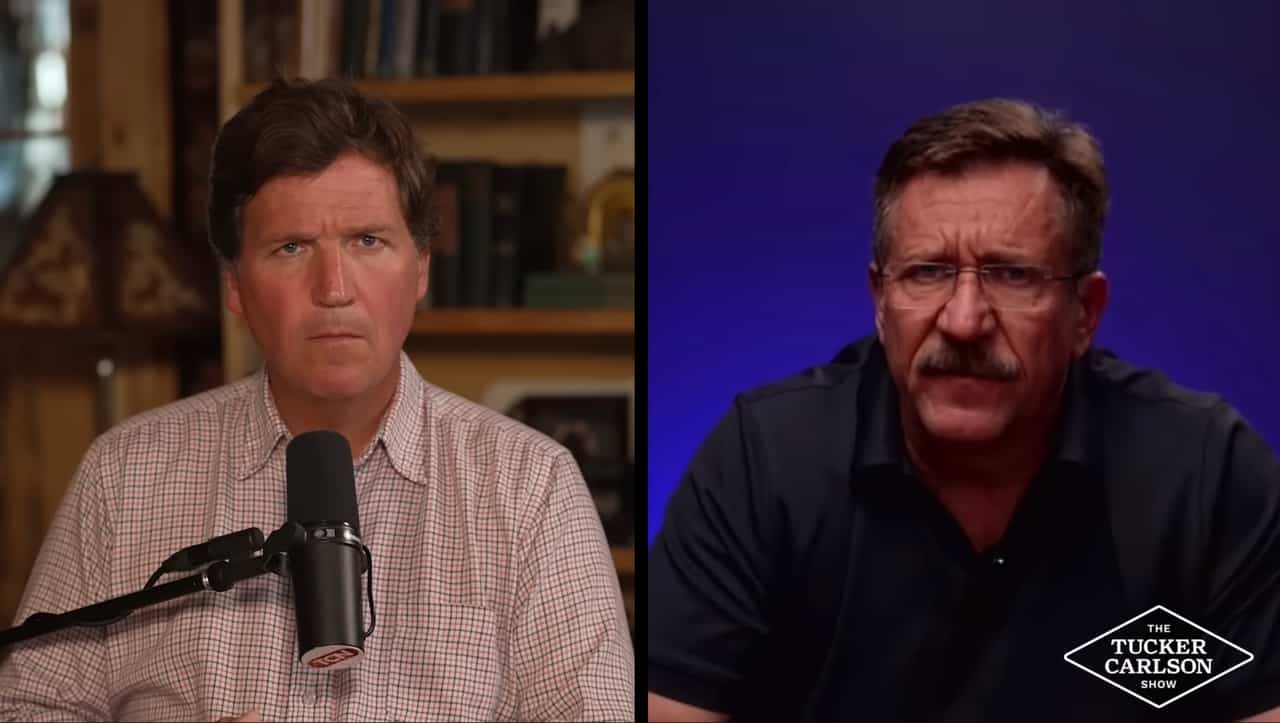
American commentator Tucker Carlson has interviewed Russian arms dealer Viktor Bout, a figure Carlson previously condemned as a serious criminal. In the interview, published on June 29, 2026, Carlson welcomed Bout to his podcast to promote Russian talking points to millions of viewers. Carlson laughingly told Bout he understood why former U.S. President Barack Obama wanted to imprison him, later calling Bout 'a very wise man.'
This interview follows Carlson's pattern of engaging with Russian figures, including Foreign Minister Sergey Lavrov and President Vladimir Putin, and advocating for closer U.S.-Russia ties. Bout, known as the 'Merchant of Death,' was sentenced to 25 years for conspiring to kill Americans but served only 10 years before being exchanged for basketball player Brittney Griner by former U.S. President Joe Biden. The Wall Street Journal reported in 2024 that Bout had returned to arms dealing, supplying weapons to Iran-backed Houthi militants.
During the interview, Bout, without pushback from Carlson, insisted that Ukraine is a pawn for its Western 'handlers' and framed the conflict as a fight against globalists. He claimed Russia has shown restraint but warned it might be forced to strike countries aiding Ukraine, deeming factories producing weapons as legitimate targets. Jade McGlynn, a researcher at King's College London, described Bout's rhetoric about restraint and potential assassinations as a 'threat dressed as reassurance,' designed to flatter Russia and pressure Kyiv.
Bout also attempted to rewrite history, calling the war in Ukraine a 'civil war' and asserting Kyiv's cultural and religious legacy predates Moscow's, obscuring Russia's historical efforts to erase Ukrainian culture. He claimed that 80% of Ukraine's population belonged to the Ukrainian Orthodox Church of the Moscow Patriarchate, a statement that overlooks the ancient founding of Kyiv's religious sites like the Kyiv Pechersk Lavra, which predates Moscow. The Moscow Patriarchate's jurisdiction over Ukrainian worshippers was imposed later through force, and its continued presence in Ukraine after independence was seen as a tool of Russian cultural imperialism.
Carlson and Bout also collaborated to portray Ukraine negatively in relation to the Middle East. They suggested Ukraine has close ties with Israel while simultaneously selling weapons to groups like Hezbollah and Hamas. This narrative emerged despite recent diplomatic tensions between Ukraine and Israel over stolen Ukrainian grain and Israel's perceived mistreatment of aid activists in Gaza. McGlynn noted that channeling anti-Ukraine sentiment through Middle East discourse is a deliberate strategy to position Israel and its partners as the problem.
Furthermore, Bout accused the Ukrainian army of terrorizing civilians, hitting children, and preventing aid delivery to the elderly. These accusations mirror documented Russian war crimes, including the use of FPV drones against civilians in cities like Kherson.