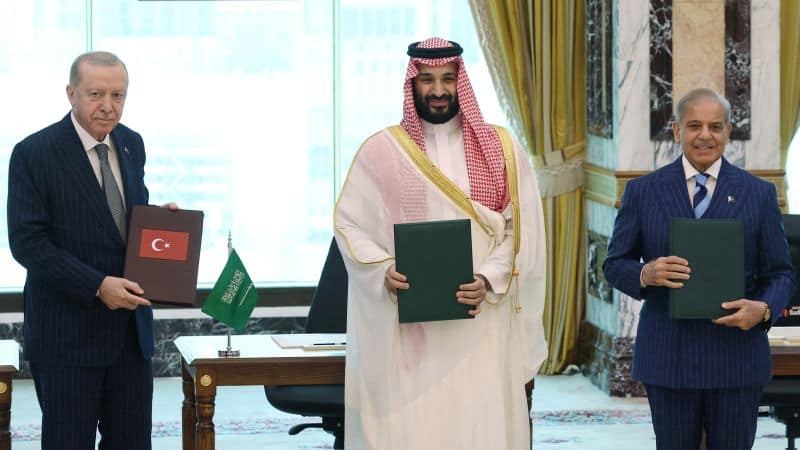
Key facts
- Saudi Arabia, Turkey, and Pakistan have signed the Mecca Joint Defence Agreement.
- The pact is a mutual defense treaty where an attack on one signatory is considered an attack on all.
- The agreement aims to bolster collective deterrence and enhance defense cooperation among the three nations.
- US President Trump lauded the pact as a significant step for regional security and self-defense.
- The treaty was ratified amid the ongoing 2026 Iran war and rising Middle East tensions.
US President Donald Trump expressed strong approval of the newly signed Mecca Joint Defence Agreement between Saudi Arabia, Turkey, and Pakistan, hailing it as a crucial step towards enhanced regional security and self-defense capabilities. The pact, signed on August 7, 2026, establishes a collective defense alliance where an attack against any one of the three nations will be regarded as an attack against all.
The agreement consolidates longstanding security ties into a formal collective-defense alliance, with the official rationale being to strengthen deterrence against aggression and improve defense cooperation. This development occurs amid heightened regional instability due to the ongoing 2026 Iran war, which has brought the conflict closer to Saudi Arabia.
Turkey, possessing NATO's second-largest military, and Pakistan, a nuclear-armed Muslim nation, provide Saudi Arabia with significant new layers of protection. This alliance is seen as a powerful, Sunni-led military front against the perceived Iranian threat, although officials have stated it is not directed against any specific actor or intended to form a sectarian bloc. The pact also allows for potential expansion to include other regional countries.
Observers noted that while the agreement mandates mutual defense, it is unlikely to extend Pakistan's nuclear deterrent to Saudi Arabia or Turkey, as Pakistan has historically reserved these capabilities for its own security. The treaty comes at a time of strained relations between Saudi Arabia and the UAE, and as Israel expands its regional military presence.
Both Pakistan and Turkey share borders with Iran and have strategic interests in preventing the conflict's escalation. The pact serves as a clear warning to Tehran, signaling that further major attacks on Saudi Arabia could invoke the treaty and draw Pakistan and Turkey into the wider conflict, potentially escalating the war significantly. Initial reactions from Tehran indicated dissatisfaction with the agreement.