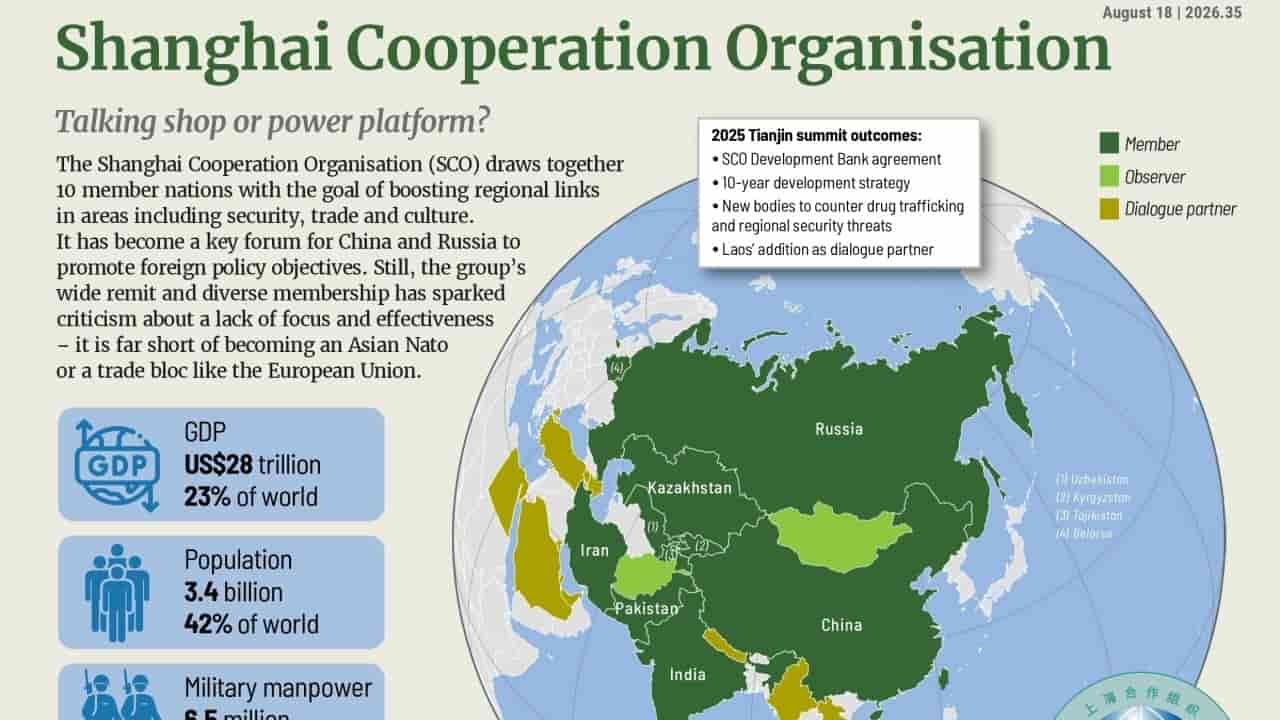
Key facts
- The Shanghai Cooperation Organization (SCO) held its 24th annual summit in Astana, Kazakhstan.
- The summit emphasized security and stability, reflecting the ongoing conflict between Russia and NATO.
- Chinese leader Xi Jinping and Russian President Vladimir Putin met to strengthen their strategic alliance.
- Belarus was officially admitted as a full member of the SCO.
- The SCO is increasingly viewed as a geopolitical counterweight to Western institutions and NATO.
The Shanghai Cooperation Organization (SCO) convened its 24th annual summit in Astana, Kazakhstan, on July 4, positioning itself as a counterweight to Western alliances like NATO. The summit, themed "Strengthening Multilateral Dialogue: Striving Towards a Sustainable Peace and Prosperity," primarily focused on security and stability, reflecting the ongoing geopolitical tensions involving Russia.
Chinese leader Xi Jinping and Russian President Vladimir Putin held bilateral talks, reinforcing their strategic partnership. Xi emphasized the convergence of interests among "global South" countries and presented the SCO as a force for "a new type of international relations" and an alternative to the Western world order. This stance is seen as a clear message to the U.S. and its allies, demonstrating that sanctions and Western threats hold less sway in a world where countries like China can bypass them by engaging with nations like Russia and Iran.
Despite its founding principles of "mutual trust, mutual benefit, equality, non-alignment, non-targeting at other countries or regions, and the principle of openness," the SCO appears to have shifted its focus towards serving as a geopolitical counterweight to the West. This is exemplified by Turkey's President Recep Tayyip Erdogan's stated desire to deepen relations with Russia and China within the SCO framework.
A significant development from the summit was the accession of Belarus as a full member, a move aligned with its anti-Western policies and strategic trajectory supporting Russia. Beyond this, approximately 25 agreements were signed across energy, security, trade, finance, and information security, though their long-term effectiveness remains to be seen. The organization covers 80 percent of the Eurasian landmass, 40 percent of the global population, and nearly 30 percent of global GDP, yet it is largely driven by Beijing and Moscow.