All NewsEducationTV
Equities & FundsCrypto & Digital AssetsAI & TechnologyBusiness & CorporateUS Politics & PolicyGeopolitics & Global RiskMacro, Rates & FXCommodities & EnergyEuropean Politics & MarketsAsia-PacificReal Estate & Property
Story archiveAll categories
← All Stories

Saudi Arabia, Turkey, Pakistan Sign Joint Defense Pact

Created at 7 Aug · 12:11 PM2 sources↑ Market-relevant2 events
IN SHORT

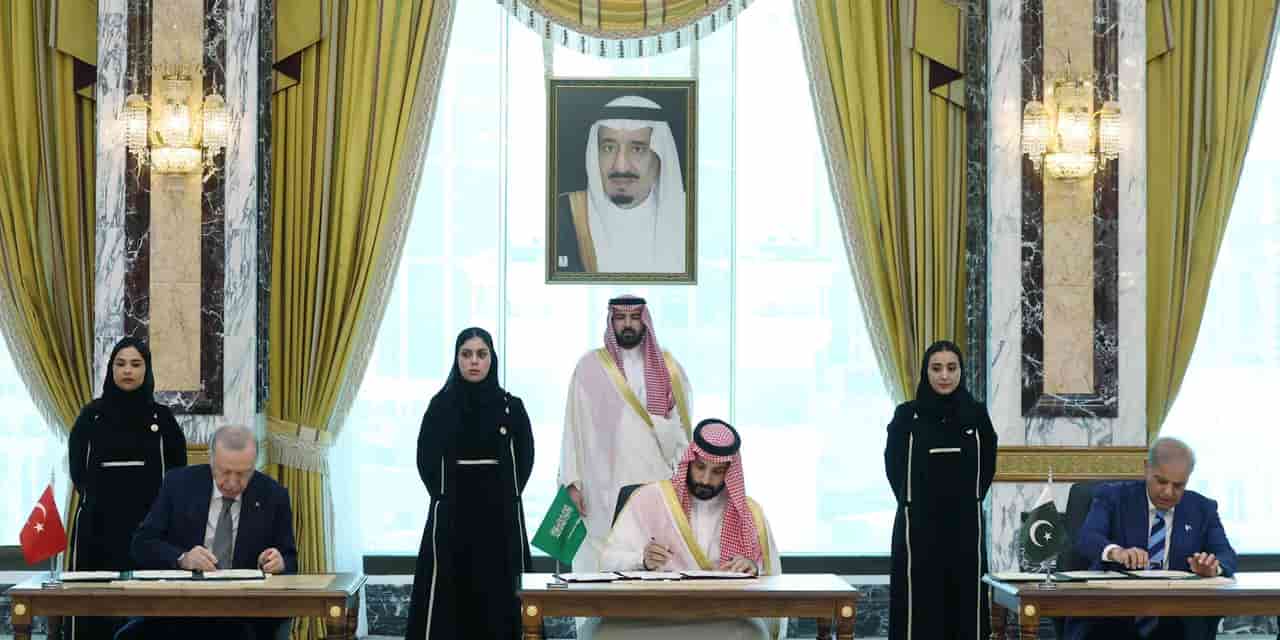
Saudi Arabia, Pakistan, and Turkey have signed a joint defense agreement in Mecca, establishing collective deterrence against aggression. The pact is intended to strengthen regional peace and stability amid escalating conflicts.

✉Newsletter

PiQ Daily

Pick your topics. Get only what matters, on your cadence.

Key Numbers

Aug. 7date of agreement signing
Feb. 28date of US and Israel attack on Iran
Oct. 7, 2023date of Hamas attack on Israel
three yearsduration of Middle East conflict
8,000Pakistani troops deployed to Saudi Arabia

Who's Involved

Tayyip Erdogan
Turkish President who signed the agreement
Mohammed bin Salman
Saudi Crown Prince who met with leaders
Shehbaz Sharif
Pakistani Prime Minister who signed the agreement
Abdulaziz Sager
Chairman of the Gulf Research Center
Asim Munir
Pakistani army chief who accompanied the Prime Minister
Mansoor Ahmed
Analyst at Australian National University's Strategic and Defence Studies Centre
Ebrahim Rezaei
Iranian lawmaker critical of the defense pact
Saudi Arabia, Turkey, Pakistan Sign Joint Defense Pact

↳ Why This Matters

The joint defense pact between Saudi Arabia, Turkey, and Pakistan signals a significant shift in regional security dynamics, potentially altering the balance of power and influencing ongoing geopolitical conflicts in the Middle East.

Key facts

  • Saudi Arabia, Pakistan, and Turkey signed a joint defense agreement in Mecca.
  • The agreement stipulates that an attack on one signatory will be considered an attack on all.
  • The pact aims to strengthen collective deterrence and promote regional peace and stability.
  • A Turkish official stated the agreement is purely defensive and not aimed at any specific country.
  • The deal follows nearly a year of negotiations and builds on existing military cooperation.

Saudi Arabia, Pakistan, and Turkey have formalized a joint defense agreement in Mecca, a move aimed at bolstering collective security amid escalating regional tensions. The pact, signed on Friday, establishes a mutual defense clause, treating an attack on any signatory as an attack on all. This trilateral agreement comes as the three Sunni Muslim U.S. allies express alarm over a widening regional conflict, particularly concerning the aggressive military stances of Israel and Iran.

The agreement, described as purely defensive and open to other regional countries, seeks to strengthen deterrence and promote peace and stability. While specific commitments were not detailed, a Turkish official emphasized its defensive nature and that it does not target any specific actor or supersede existing arrangements. The pact is seen as a significant political statement by three influential Muslim nations coordinating on security matters during a period of heightened uncertainty.

Turkey possesses NATO's second-largest military, Saudi Arabia is a major Gulf power and oil exporter, and Pakistan is a nuclear-armed nation. The leaders met with Saudi Crown Prince Mohammed bin Salman, whose country has faced repeated attacks from Iran and its allies. The conflict has disrupted regional security and vital shipping lanes, including the Strait of Hormuz. This defense pact follows nearly a year of negotiations and builds upon long-standing bilateral military ties, with Pakistan and Turkey contributing defense industries and Saudi Arabia potentially offering technological investment. However, a nuclear component is unlikely, as Pakistan's atomic deterrent is focused on India.

An Iranian lawmaker, Ebrahim Rezaei, criticized the agreement, stating that paper agreements with Turkey and Pakistan would not bring security to Saudi Arabia, and that Riyadh should focus on changing its policies rather than seeking security from others.

Frequently asked questions

The agreement aims to strengthen collective deterrence against aggression and promote peace, security, and stability in the region and beyond.

According to a Turkish official, the agreement is purely defensive in nature, not directed against any specific actor, and is open to other regional countries.

Pakistan and Turkey offer strong defense industries, while Saudi Arabia could contribute with technological spending. Pakistan has also deployed troops and military assets to Saudi Arabia.

The agreement is signed amid escalating regional conflicts, including attacks on Saudi Arabia by Iran and its allies, and concerns over the military stances of Israel and Iran.

What Happens Next

01The agreement is open to other regional countries.
02Further concrete cooperation is expected to emerge from the trilateral framework.

Get the newsletter.

Pick the topics you actually care about. We'll email when there's news worth your time, on the cadence you choose. Cancel any time from your account.

Cadence

How It Developed

Saudi Arabia, Pakistan, and Turkey signed a joint defense agreement in Mecca.
The agreement establishes collective deterrence against aggression.
An Iranian lawmaker criticized the defense pact, stating it would not bring security to Saudi Arabia.
The Iranian lawmaker suggested Saudi Arabia should change its policies instead of seeking security from others.

Sources

T1
Saudi Arabia, Turkey, Pakistan seal joint defense agreementNikkei Asia
T1
Iranian lawmaker criticises new "Mecca Joint Defence Agreement"Middle East Eye

Related Stories

Erdogan, Saudi, Pakistan leaders to sign defence deal amid Iran tensions
6 Aug · 7:16 PM
Saudi Arabia Warns of Imminent Houthi Attacks Coordinated by Iran
6 Aug · 9:16 PM
Korean War allies convene in Washington to bolster solidarity
6 Aug · 11:41 PM
US calls Israel-Lebanon talks 'fruitful' as fighting escalates
6 Aug · 6:51 PM
US military aware of N.K. missile launch, reaffirms allied defense
6 Aug · 6:36 PM