HomeEverything
Equities & FundsCrypto & Digital AssetsAI & TechnologyBusiness & CorporateUS Politics & PolicyGeopolitics & Global RiskMacro, Rates & FXCommodities & EnergyEuropean Politics & MarketsAsia-PacificReal Estate & Property
← All Stories

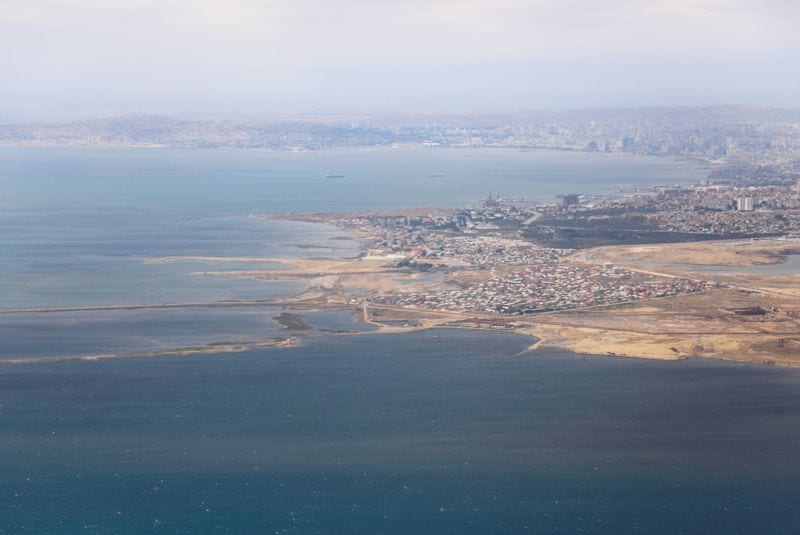
Regional framework to monitor shrinking Caspian Sea could be established this year

Created at 30 Jun · 2:00 PM1 source↑ Market-relevant
IN SHORT

Azerbaijan's State Water Resources Agency proposes a regional legal framework by year-end to monitor and adapt to the Caspian Sea's accelerated shrinking, driven by climate change and reduced river flows.

✉Newsletter

PiQ Daily

Pick your topics. Get only what matters, on your cadence.

Key Numbers

20-30 cmannual Caspian Sea retreat rate
1 meterCaspian Sea level drop in 5 years
1.5 metersCaspian Sea level drop in 10 years
2.5 metersCaspian Sea level drop in 30 years

Who's Involved

Aliagha Azizov
Deputy head of Azerbaijan's State Control Service for Water Use and Protection
Azerbaijan's State Water Resources Agency
Proposing a regional cooperation framework for the Caspian Sea
Regional framework to monitor shrinking Caspian Sea could be established this year

↳ Why This Matters

The Caspian Sea's rapid decline threatens vital economic sectors and infrastructure for surrounding nations, necessitating urgent regional cooperation and adaptation strategies to mitigate environmental and economic impacts.

Key facts

  • A regional legal framework for monitoring the Caspian Sea could be established by the end of the year.
  • The Caspian Sea's water level has dropped by approximately 2.5 meters over the last 30 years.
  • The sea is currently shrinking at a rate of 20-30 centimeters per year.
  • Key causes include climate change, reduced rainfall, and increased evaporation.
  • Ports, fisheries, tourism, and offshore infrastructure are vulnerable to the shrinking sea.

A senior Azerbaijani water official has proposed the establishment of a regional legal framework by the end of this year to address the accelerated shrinking of the Caspian Sea. Aliagha Azizov, deputy head of the State Control Service for Water Use and Protection at Azerbaijan's State Water Resources Agency, stated that the world's largest inland body of water has fallen by approximately 2.5 meters over the past 30 years, with current retreat rates reaching 20-30 centimeters annually.

Azizov attributed the phenomenon primarily to climate change, lower rainfall across the sea basin, increased evaporation due to rising temperatures, and reduced river flows. He noted that this rapid decline poses significant vulnerabilities to ports, shipping, fisheries, coastal tourism, and offshore oil and gas infrastructure. While the five surrounding countries are cooperating on environmental protection, a fully functioning regional monitoring system is currently lacking.

The proposed framework aims to strengthen cooperation through enhanced monitoring, data exchange, joint scientific research, forecasting, and adaptation measures. Azizov indicated that this legal structure could be finalized within the current year.

Frequently asked questions

The primary causes are climate change, reduced rainfall, higher evaporation due to rising temperatures, and diminished river flows into the sea.

The sea is currently retreating by 20-30 centimeters per year, a rate significantly faster than global sea level rise.

Vulnerabilities are increasing for ports, shipping, fisheries, coastal tourism, and offshore oil and gas infrastructure.

The five countries surrounding the sea are Azerbaijan, Kazakhstan, Russia, Iran, and Turkmenistan.

What Happens Next

01Completion of a legal framework for regional cooperation on Caspian Sea monitoring by year-end.

Get the newsletter.

Pick the topics you actually care about. We'll email when there's news worth your time, on the cadence you choose. Cancel any time from your account.

Cadence

How It Developed

The Caspian Sea's water level has fallen by approximately 2.5 meters over the past 30 years.
The sea is currently retreating by 20-30 centimeters annually, significantly faster than global sea level rise.
Scientific studies indicate falling water levels since the mid-1990s, attributed to climate change, lower rainfall, and increased evaporation.
Ports, fisheries, tourism, and offshore infrastructure are increasingly vulnerable due to the receding waters.
A senior Azerbaijani official proposed a regional legal framework for cooperation by the end of the year.
This framework aims to enhance monitoring, data exchange, research, and adaptation measures among Caspian Sea nations.

Sources

T1
Regional framework could be set up to monitor rapidly shrinking Caspian Sea, Azerbaijani official saysReuters

Related Stories

Russians' economic pessimism highest in 20 years: Gallup
30 Jun · 1:20 PM
Von der Leyen visits Azerbaijan, Armenia to boost EU ties, energy, and peace
30 Jun · 1:05 PM
Estonia images show machine guns on Russian LNG carrier in Baltic
30 Jun · 12:53 PM
China urges US and Iran to maintain talks momentum
30 Jun · 2:45 PM
Bird nests made of fibre-optic cables found near Ukraine war front
30 Jun · 7:36 AM