Key facts
- The Patriot system is a mobile surface-to-air missile defense system capable of intercepting aircraft, tactical ballistic missiles, and cruise missiles.
- Interceptor missiles include the PAC-2 GEM-T and the more advanced PAC-3 MSE.
- The system's radar can track over 150 km and simultaneously monitor up to 100 targets.
- Nineteen countries operate the Patriot system, with six to eight requesting additional missiles.
- A Patriot battery costs over $1 billion, with interceptors estimated at $4 million to $5 million each.
- U.S. Patriot interceptors are estimated to have decreased by about 65% between February and July.
The U.S. Patriot air defense system, first deployed in the 1991 Gulf War, is experiencing unprecedented demand, leading to depleted global supplies of its interceptor missiles. This surge is driven by Ukraine's ongoing defense against Russian invasions and the widening conflict in the Middle East. Ukraine is particularly in urgent need of these interceptors to counter daily Russian ballistic missile attacks.
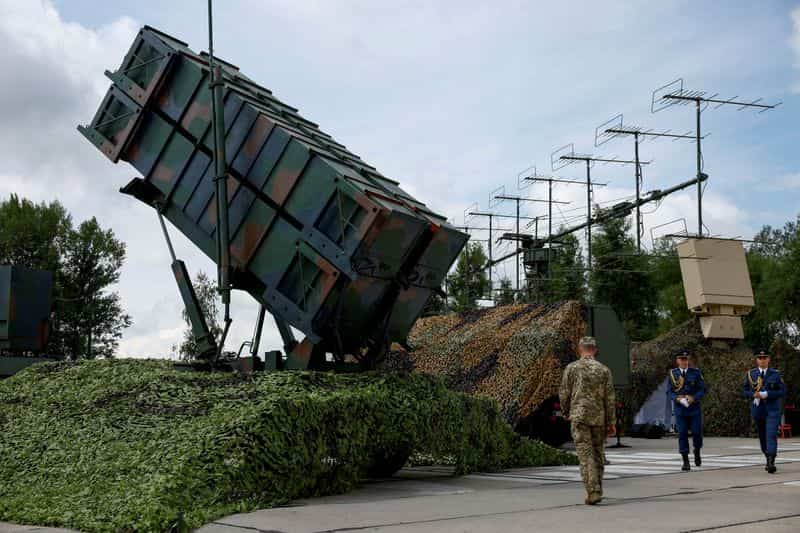
The Patriot system, short for Phased Array Tracking Radar for Intercept on Target, is a mobile, all-weather, long-range surface-to-air missile defense system manufactured by Raytheon Technologies. Developed in the 1980s and continuously modernized, it is expected to remain in service through 2048. A standard battery comprises radar and control systems, a power unit, launchers, and support vehicles.
Depending on the interceptor used, the Patriot system can engage aircraft, tactical ballistic missiles, and cruise missiles. Earlier PAC-2 interceptors utilize a blast-fragmentation warhead, while the more advanced PAC-3 family employs "hit-to-kill" technology for direct impact. Raytheon produces the PAC-2 GEM-T, effective against shorter-range ballistic missiles, cruise missiles, and enemy aircraft. Lockheed Martin manufactures the PAC-3 Missile Segment Enhancement (MSE), capable of intercepting longer-range ballistic missiles, cruise missiles, aircraft, and hypersonics. Lockheed also introduced the PAC-3 Adapted Capability Effector (ACE) interceptor, designed to be more cost-effective while targeting short-range ballistic missiles, aircraft, and cruise missiles.
The system's radar boasts a range exceeding 150 km and can track up to 100 potential targets simultaneously, according to NATO data from 2015. While not initially designed for hypersonic weapons, Ukraine reported in May 2023 that its Patriot system successfully intercepted a Russian Kinzhal missile, which Moscow claims is hypersonic.
While specific inventory figures are classified, estimates suggest that approximately 65% of U.S. Patriot interceptors were used between February and July, leaving fewer than 850 missiles, a significant decrease from the 2,330 available before the recent escalation in the Middle East. Inventories in Gulf states are also severely depleted, and several European nations have transferred some of their missile stocks to Ukraine. Raytheon has delivered over 240 Patriot fire units globally, with nineteen countries currently operating the system, including the U.S., Germany, Poland, Ukraine, Japan, Qatar, Saudi Arabia, and Egypt. Sixteen of these nations possess the latest PAC-3 MSE missiles, and six to eight countries have requested additional interceptors to replenish their dwindling supplies.
A single Patriot battery is estimated to cost over $1 billion, comprising $400 million for the system itself and $690 million for the missiles. Individual PAC-3 interceptors are priced between $4 million and $5 million. The U.S. is reportedly in discussions to allow Ukraine to manufacture Patriot interceptor missiles, despite doubts cast by President Donald Trump on such a deal. These discussions include provisions for Ukraine to produce certain components for final assembly in Europe. In response to the demand, the U.S. Army awarded Lockheed Martin a contract valued up to $58.6 billion for the production of Patriot interceptor missiles.