Key facts
- Preliminary investigations link the group behind Damascus bombings to Islamic State.
- Islamic State established a caliphate in Iraq and Syria from 2014-2017.
- The group now operates in scattered cells across the Middle East, Africa, Afghanistan, and Pakistan.
- Africa constitutes the majority of Islamic State's global activity.
- Islamic State has recently been linked to attacks in Syria, Russia, and Afghanistan.
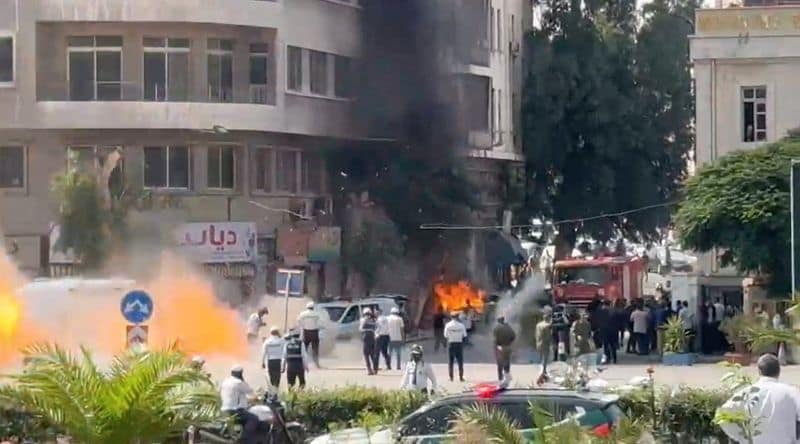
Preliminary investigations into the cell behind Tuesday's bombings in Damascus, near a hotel where French President Emmanuel Macron spent the night, indicate it was affiliated with Islamic State, a senior Syrian security official said. Two bombs exploded near the hotel, wounding 18 people and overshadowing Macron's visit.
The Sunni Muslim group emerged in Iraq and Syria, quickly creating a "caliphate" and declaring its rule over all Muslims, largely displacing al Qaeda. At its height from 2014-2017, it held swathes of Iraq and Syria, ruling over millions and strictly imposing its interpretation of Islamic Sharia law with shocking brutality. Its fighters carried out or inspired attacks in dozens of cities worldwide.
After being ousted from its bases in Raqqa and Mosul, the group took refuge in the hinterlands of Iraq and Syria. It retains a significant presence in these countries, as well as parts of Africa, Afghanistan, and Pakistan. Fighters are scattered in autonomous cells, and its leadership is clandestine, making its overall size hard to quantify, with the UN estimating 10,000 members in its heartlands.
Africa is now the focus of the group's operations, accounting for 86% of its global activity in the first three months of 2026, according to the Armed Conflict Location & Event Data Project. Northeastern Nigeria is the primary base of the biggest faction, ISWAP, but other branches operate in the Sahel, Somalia, Mozambique, and Congo. Morocco's counterterrorism agency recently foiled attack plots by a cell loyal to Islamic State's affiliate in the Sahel. Many foreign fighters have joined Islamic State's Khorasan branch (ISIS-K), and affiliates remain active in southern Philippines.
Middle Eastern leaders and their Western allies have warned that Islamic State could exploit the 2024 toppling of Bashar al-Assad's government to stage a comeback. Since Assad's fall, Islamic State has been activating sleeper cells and distributing weapons. The group has also inspired lone-wolf attacks, such as the 2025 shooting at a Jewish Hanukkah event in Sydney and the 2024 mass shooting at a concert hall near Moscow claimed by ISIS-K.
Islamic State's aim is to spread its extreme form of Islam and rule over Muslims. It has adopted new tactics since losing its territorial strongholds, transforming into a dispersed underground movement that depends on clandestine cells and discreet courier networks. The group has embraced a decentralized structure, granting greater autonomy to smaller groups and individual militants to withstand counterterrorism campaigns.