Key facts
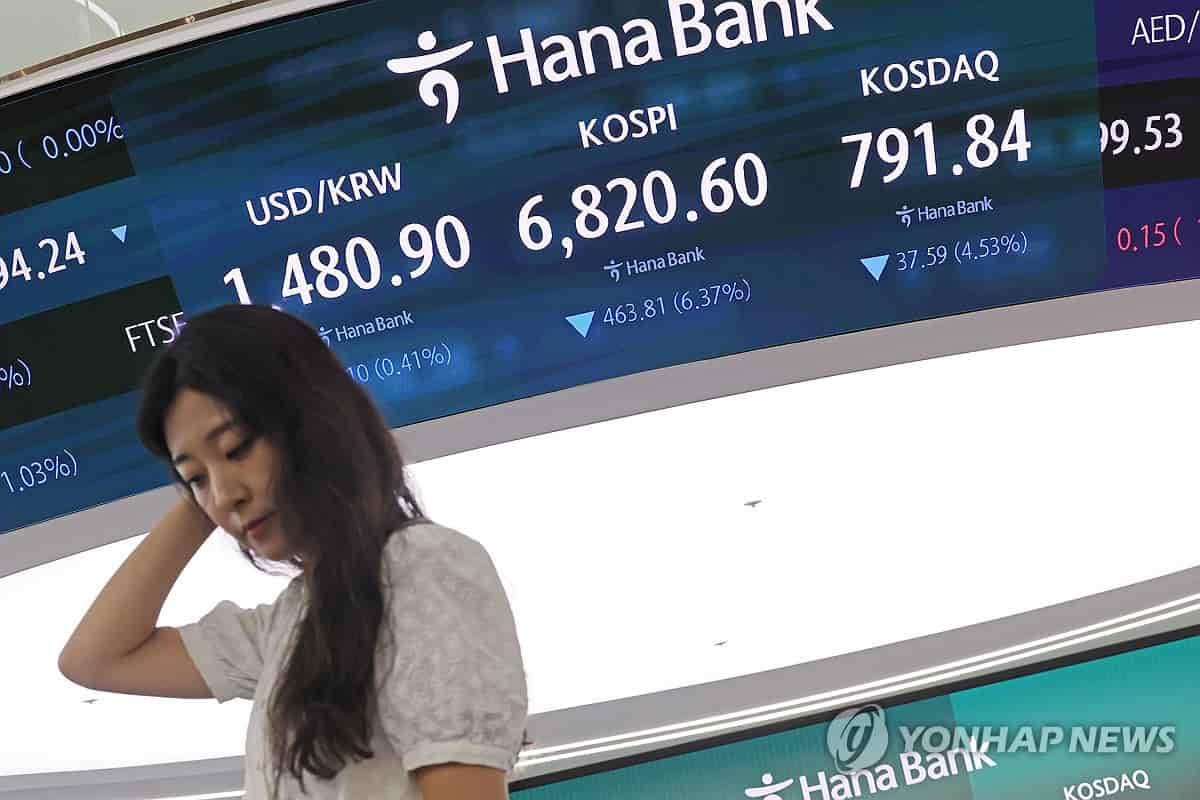
- South Korean stocks closed more than 4 percent lower on Monday, July 20, 2026.
- The benchmark Korea Composite Stock Price Index (KOSPI) plunged 304.33 points, or 4.46 percent, to 6,516.27 points.
- Concerns over global spending on AI infrastructure, including semiconductors, resurfaced following the unveiling of a new AI model by Chinese startup Moonshot.
- Escalating tensions in the Middle East, including the death of a U.S. soldier in Iraq, also weighed on investor sentiment.
- The Korean won rose against the U.S. dollar.
South Korean stocks concluded Monday's trading session with a significant decline of over 4 percent, primarily driven by renewed concerns in the artificial intelligence (AI) chip sector and heightened geopolitical tensions in the Middle East. The benchmark Korea Composite Stock Price Index (KOSPI) saw a substantial drop of 304.33 points, or 4.46 percent, closing at 6,516.27 points, after hitting an intraday low of 6,472.80.
Analysts attributed the market downturn to a combination of factors. Lee Kyoung-min, an analyst at Daishin Securities, noted that unfavorable developments related to semiconductors and worsening conflict risks between the United States and Iran dampened investor sentiment. Specifically, the recent unveiling of a new AI model by Chinese startup Moonshot, named Kimi K3, raised questions about the sustainability of massive capital expenditures by hyperscalers on AI infrastructure, potentially impacting semiconductor demand. This development followed a decline in U.S. semiconductor stocks on Friday.
Simultaneously, escalating tensions in the Middle East contributed to the negative market mood. The U.S. military's announcement of a third U.S. soldier's death in Iraq amid ongoing exchanges between the U.S. and Iran added to global risk aversion. Despite the stock market's decline, the Korean won strengthened against the U.S. dollar.