Key facts
- MSCI has proposed new rules that could exclude companies holding significant non-operating assets, such as major Bitcoin treasury firms, from its Global Investable Market Indexes.
- The proposed exclusion criteria involve a two-step screen: first, checking if operating assets exceed 50% of total assets, and second, evaluating five financial ratios.
- Companies failing at least four of the five financial ratios would be deemed ineligible for index inclusion.
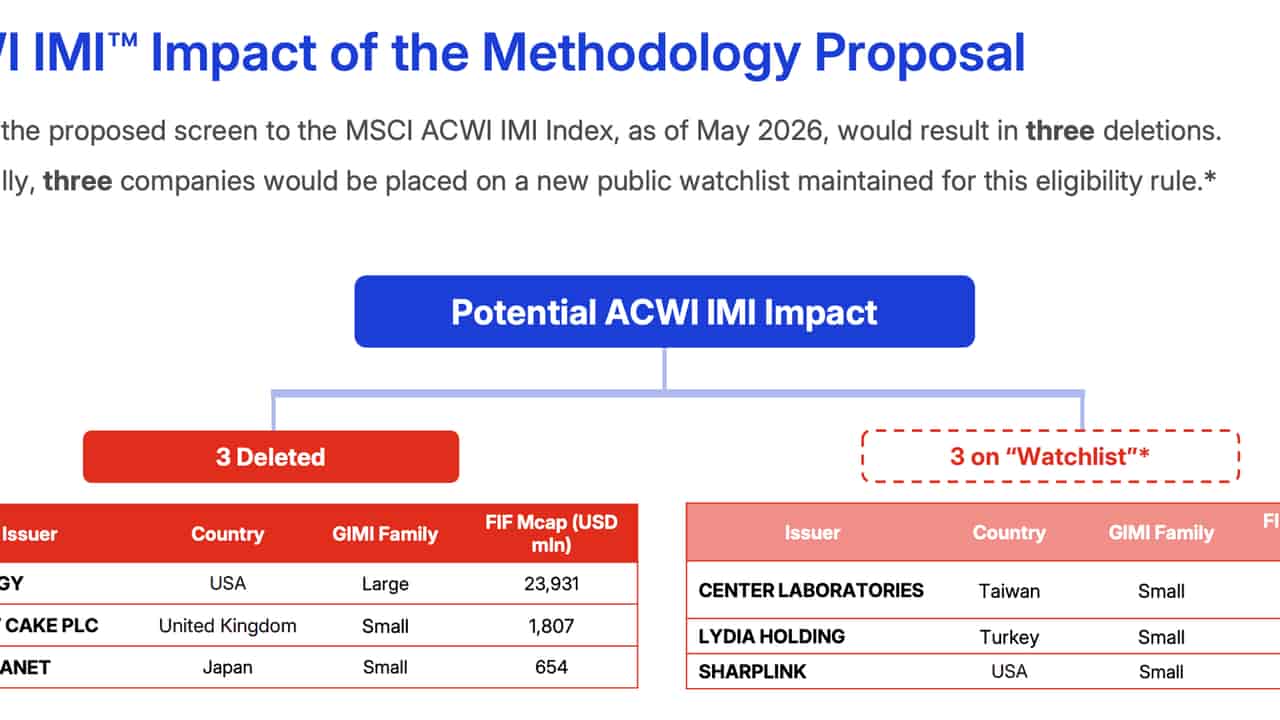
- If implemented, MicroStrategy, Metaplanet, and uranium holder Yellow Cake could be removed from the MSCI ACWI IMI Index.
- MSCI is currently consulting on the proposal, with feedback accepted until September 30, and any changes would not take effect before November 2026.
Index provider MSCI has initiated a new consultation that could lead to the exclusion of companies considered "non-operating," a category that may encompass major Bitcoin treasury firms like MicroStrategy and Metaplanet, from its Global Investable Market Indexes. The proposed rules involve a two-step screening process. The first step checks if a company's operating assets constitute more than 50% of its total assets. If this condition is not met, the company proceeds to a second exclusion screen that evaluates five financial ratios: operating asset intensity, expense intensity, cash flow, fair value intensity, and capital dependence. A company would be deemed ineligible for index inclusion if it fails at least four of these five ratios.
Based on current data, this screen would have resulted in the removal of MicroStrategy, Metaplanet, and Yellow Cake from the MSCI ACWI IMI Index. MicroStrategy, the largest publicly listed Bitcoin holder with 840,447 BTC ($53.18 billion), and Metaplanet, with 43,000 BTC (over $2 billion), are specifically mentioned as potentially affected. MSCI is currently seeking feedback from market participants on this proposal, with the consultation period running until September 30. Any changes resulting from this consultation would be implemented no earlier than the November 2026 index review.