Key facts
- The stock market's value has more than doubled over the past decade, reaching over $75 trillion.
- AI-related stocks are responsible for about half of the S&P 500's gains this year.
- The 'Magnificent Seven' companies (Meta, Alphabet, Amazon, Apple, Tesla, Nvidia, Microsoft) represent roughly a quarter of the U.S. stock market's value.
- A 30% drop in the stock market could reduce consumer spending by nearly $700 billion due to the wealth effect.
- Investment in AI is driving capital into semiconductor factories, data centers, and power infrastructure.
The U.S. stock market's performance is increasingly intertwined with the economy, largely driven by a boom in artificial intelligence and related companies. This AI-fueled surge has pushed major indexes to record highs, with investor appetite for AI-connected assets showing no signs of waning. The total value of the U.S. stock market has more than doubled in the last decade, now standing at over $75 trillion, a ratio significantly larger than the nation's annual economic output.
While much of this market value represents bets on future profits, the current AI boom is translating into tangible economic activity. Trillions of dollars are being invested in critical infrastructure such as semiconductor factories, data centers, and power grids. This investment, coupled with the wealth generated from appreciating stock portfolios, is stimulating consumer spending, particularly among affluent individuals who are more inclined to purchase luxury goods and services.
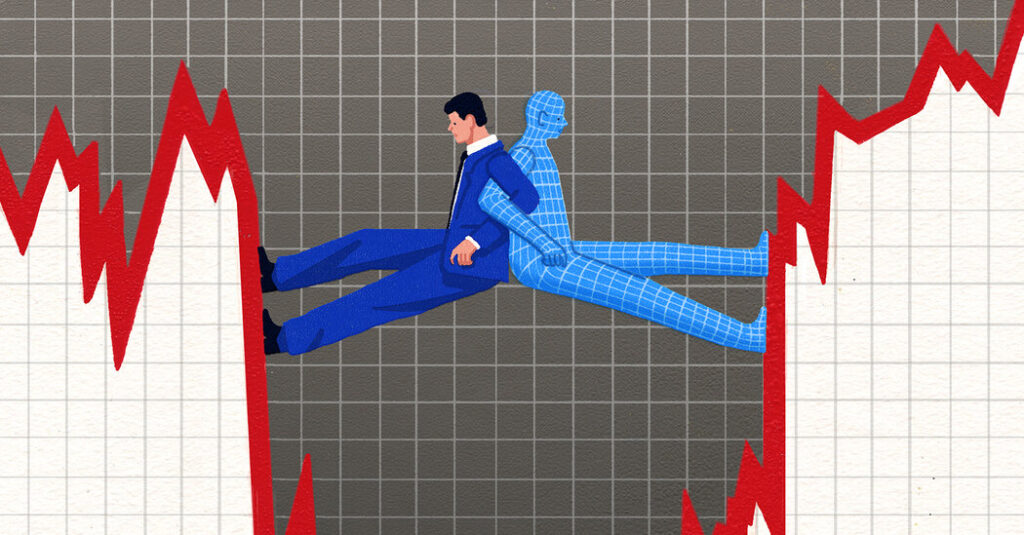
This AI-driven economic engine has helped the U.S. navigate a challenging period marked by inflation, trade disputes, and geopolitical instability. However, this reliance on a single sector creates a significant vulnerability. A decline in investor confidence in AI could lead to a sharp contraction in economic activity. Bank of America's latest global fund-manager survey identified the bursting of the AI bubble as the primary risk to financial markets and, by extension, the economy.
Economists note that the AI narrative has been the primary support for the market. AI-related stocks are estimated to account for roughly half of the S&P 500's gains this year, with economic growth also becoming increasingly dependent on AI infrastructure spending. This has led to a situation where the market is becoming a "big AI trade."
Despite recent market fluctuations indicating investor concern about this concentration, significant drops have historically rebounded quickly. However, the sheer scale of the current stock market, combined with the wealth effect—where every $100 in stock portfolio gains leads to about $3 in consumer spending—could make this downturn more impactful. A 30% market decline could result in a nearly $700 billion reduction in consumer spending, potentially triggering or nearing a recession.
The concentration of value in a few key companies, including Meta, Alphabet, Amazon, Apple, Tesla, Nvidia, and Microsoft (the "Magnificent Seven"), which collectively represent about a quarter of the U.S. stock market's value, further amplifies this risk. A stumble by one of these dominant AI players could have widespread repercussions.