Key facts
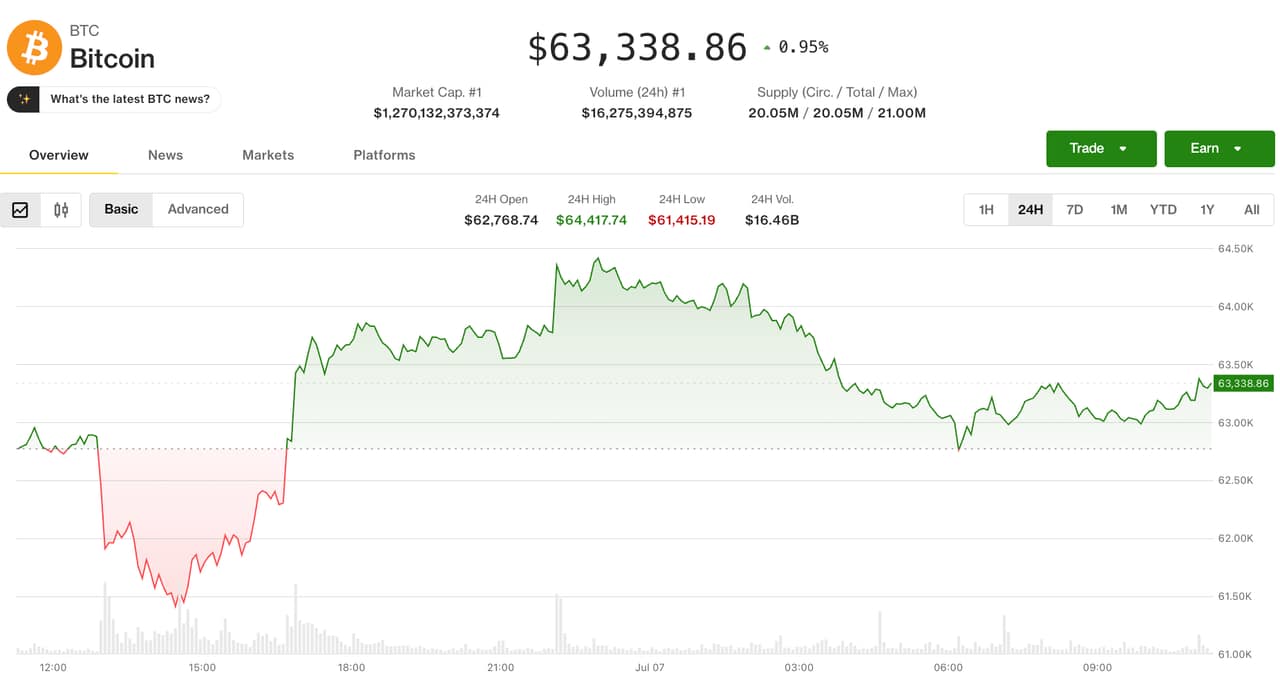
- Bitcoin fell from a two-week high of $64,500.
- Over $500 million in leveraged crypto futures positions were liquidated in 24 hours, predominantly shorts.
- Bitcoin's futures open interest has decreased, suggesting derivative traders are not participating in the price rise.
- Weak ETF flows and a negative Coinbase premium also indicate a lack of sustained demand.
- The altcoin market shows fragmentation, with some tokens gaining significantly while others decline.
- The combined market cap of USDT and USDC has declined, suggesting net capital outflows from the crypto market.
Bitcoin's recent rally has stalled, falling from a two-week high of $64,500 as indicators suggest a lack of sustained demand. The cryptocurrency's price on Tuesday was $63,139.66, after reaching a six-day winning streak. Concerns are mounting due to a negative Coinbase Premium for 50 consecutive days, indicating weaker demand in the U.S. compared to Binance, which does not operate in the U.S. Furthermore, U.S. spot Bitcoin ETFs have experienced eight straight weeks of net outflows, casting doubt on institutional conviction.
Futures market data also points to waning momentum. Bitcoin's futures open interest has decreased to 740,000 BTC from a peak of 776,000 BTC on July 3, suggesting derivative traders are not actively participating in the current price rise. Over $500 million in leveraged crypto futures positions were liquidated in the past 24 hours, with short positions bearing the brunt, indicating a potential short squeeze rather than broad bullish sentiment.
Ether (ETH) followed Bitcoin's downward trend, and Solana (SOL) also saw a decline in its futures open interest. The altcoin market is fragmented, with some tokens like ETHFI and LIT showing significant weekly gains, while others have declined. The WLFI token, linked to Donald Trump's family, saw a modest increase but remains down significantly from its inception. Analysts at Bitfinex noted that sustained inflows into BlackRock's ETF are crucial to validate the institutional bid, while QCP Capital suggested a reclaim of the $64,000 level could improve sentiment.
External factors also pose potential headwinds. Japanese bond yields have surged to a 30-year high, which could increase borrowing costs globally and pressure risk assets like Bitcoin. The combined market capitalization of stablecoins USDT and USDC has declined to $257 billion from $268 billion over the past two months, suggesting net capital outflows from the crypto market.