Key facts
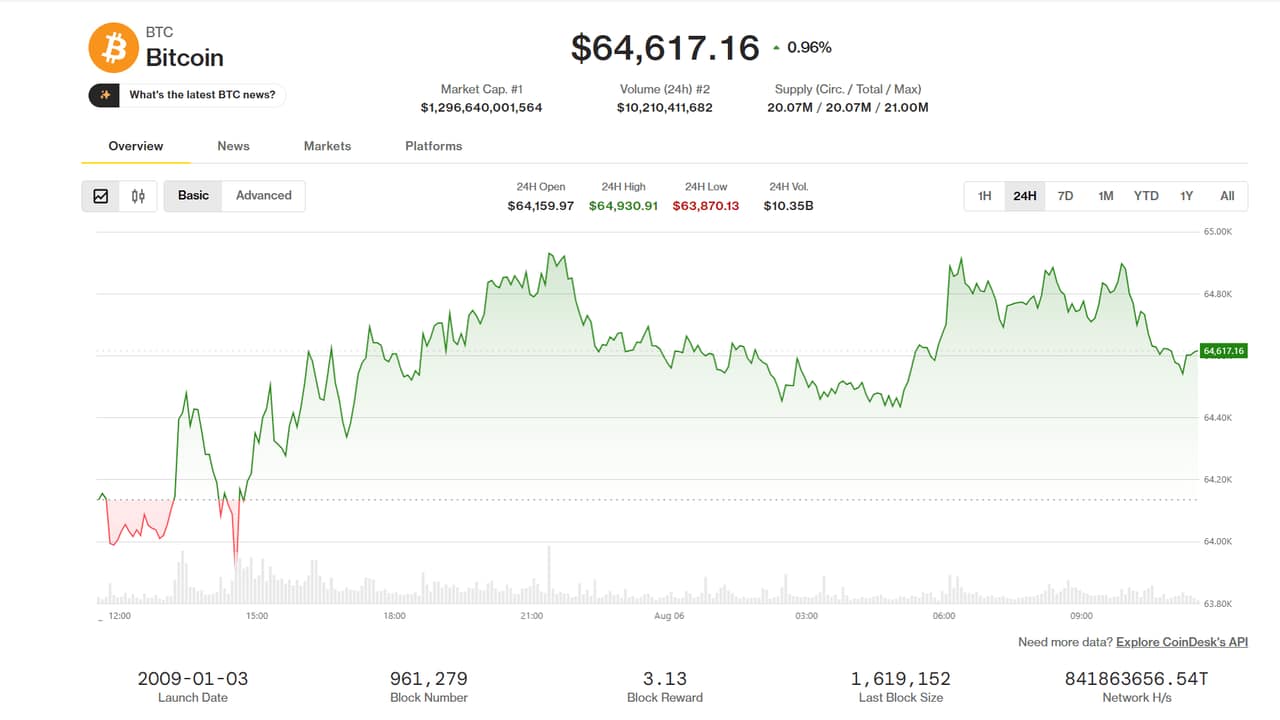
- Bitcoin is up around 0.9% in 24 hours, trading at $64,700.
- The broader CoinDesk 20 (CD20) index is up only 0.16%.
- Altcoin open interest has fallen approximately 15% in the past month.
- Bitcoin's futures open interest has increased to 770K BTC.
- XRP's open interest has risen 5% while its price has fallen to $1.04.
- NEAR's stake-to-compute model aims to tie its token to AI computing power.
Bitcoin has seen a modest gain of around 0.9% in the past 24 hours, reaching $64,700, while the broader CoinDesk 20 index has risen by only 0.16%. This performance indicates a rotation by traders towards larger-cap cryptocurrencies like bitcoin and ether, perceived as safer havens amidst broader market conditions. Altcoins are reportedly struggling without the momentum generated by bitcoin's upward movement, with altcoin open interest falling approximately 15% over the past month, compared to an 8% gain for bitcoin.
Analysts suggest that bitcoin's integration into capital markets through ETFs and institutional hedging provides a stable foundation, unlike many altcoins that have not yet made this transition. The value accrual for many altcoin projects remains unclear, making them less attractive during market downturns. The recent weakness in tech stocks, including a drop in the Nasdaq 100, following SpaceX's AI-linked capital spending report, may also be contributing to capital rotation away from crypto, though its reversal could potentially renew interest.
Derivatives data show a cautiously bullish sentiment for bitcoin. The long-short taker volume ratio has flipped bullish, with longs accounting for nearly 52%. Bitcoin's futures open interest has increased to 770K BTC, though its sustainability is being watched. Annualized perp funding rates and cumulative volume delta are also positive for BTC. In contrast, XRP is showing signs of market weakness, with rising open interest alongside a falling price, negative funding rates, and highly negative OI-adjusted CVD. Ether's open interest remains flat, while Solana's futures open interest has declined from its recent peak.
NEAR Protocol has introduced a stake-to-compute model, allowing token holders to lock NEAR to provision computing power for AI applications. However, analysts like Leo Fan, CEO of Cysic, caution that the model's success hinges on sustained real demand for compute power beyond initial incentives and subsidies. The key metrics to watch are utilization, workload volume, and developer retention after subsidies taper. This model is seen as a test case for other projects in the AI-crypto space aiming to provide clearer economic utility beyond governance or speculation.