Key facts
- Motor speed on hammermills can be adjusted with a variable frequency drive.
- Adjusting motor speed allows for external particle size adjustments without changing screens.
- Screen hole diameter and hammer tip speed were tested at three levels each.
- Increasing hammer tip speed reduced geometric mean diameter and geometric standard deviation.
- Increasing screen hole diameter decreased angle of repose.
Researchers have evaluated how motor speed and screen hole diameter influence the performance of hammermills, crucial equipment in feed production. A key finding is that installing a variable frequency drive (VFD) on the motor allows for adjustments to motor speed and, consequently, hammer tip speed. This capability enables external modification of particle size without the need to physically change screens, thereby reducing operational downtime.
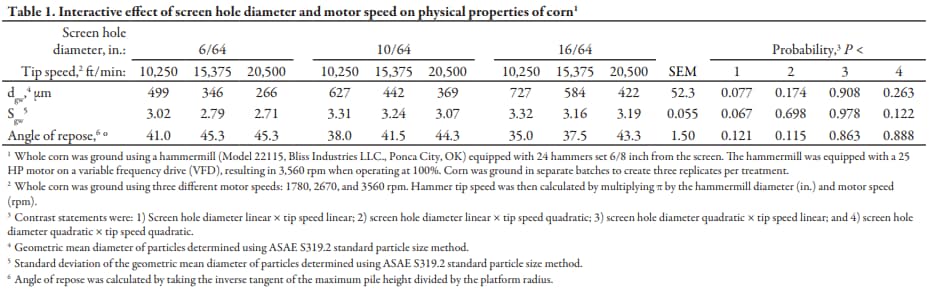
The study examined three screen hole diameters (6/64, 10/64, and 16/64 inches) and three hammer tip speeds (10,250, 15,375, and 20,500 ft/min). Results indicated a significant interaction between screen hole diameter and tip speed for geometric mean diameter (dgw) and geometric standard deviation (Sgw). Specifically, as tip speed increased, the reduction in dgw was more pronounced with larger screen hole diameters. For Sgw, the rate of decrease was smaller as screen hole diameter increased with higher tip speeds.
Furthermore, increasing hammer tip speed linearly increased the angle of repose (AoR), while increasing screen hole diameter linearly decreased it. No interaction was observed between screen hole diameter and tip speed for AoR. The findings suggest that particle size ranges can be effectively adjusted by manipulating hammer tip speed, offering feed mill operators a more efficient method to meet specific particle size demands for animal diets.