All NewsEducationTV
Equities & FundsCrypto & Digital AssetsAI & TechnologyBusiness & CorporateUS Politics & PolicyGeopolitics & Global RiskMacro, Rates & FXCommodities & EnergyEuropean Politics & MarketsAsia-PacificReal Estate & Property
Story archiveAll categories
← All Stories

China's high-tech hubs lead uneven economic growth

Created at 28 Jul · 8:11 AM1 source↑ Market-relevant
IN SHORT

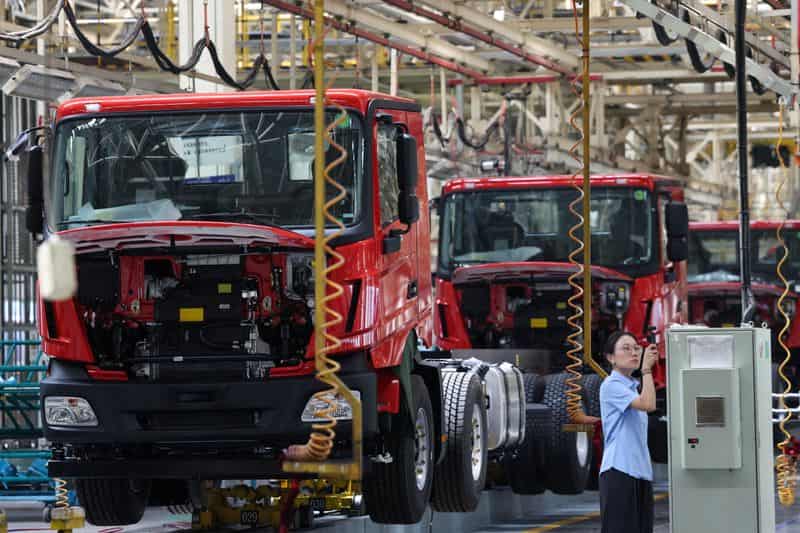
China's regional economic data for the first half of 2026 reveals a widening gap between provinces focused on high-tech manufacturing and those reliant on traditional industries. While advanced manufacturing hubs like Guangdong and Zhejiang accelerated, regions dependent on property and older sectors lagged, complicating national economic policy.

✉Newsletter

PiQ Daily

Pick your topics. Get only what matters, on your cadence.

Key Numbers

4.7%national GDP growth in first half 2026
5.7%Zhejiang province growth rate
5.6%Shandong, Anhui, and Shanghai growth rates
2.74 trillion yuanAnhui's GDP in first half
$404.9 billionAnhui's GDP in first half
44.6%Anhui's high-tech manufacturing output surge
29%Anhui's auto manufacturing rise
20.6%Anhui's new-energy vehicle output rise
16.2%Anhui's industrial robots output rise
37.6%Anhui's total exports soar
78.3%Anhui's high-tech exports rise
33.7%Anhui's property investment decline
1.6%Anhui's retail sales rise
0.7%
Shanghai's retail sales growth
-2.2%Beijing's retail sales decline
6.8%Shanghai's fixed-asset investment rise
3%Beijing's fixed-asset investment rise

Who's Involved

Ellen Zhang
Reuters reporter
Kevin Yao
Reuters reporter
Zhaopeng Xing
ANZ's senior China strategist
Xi Jinping
President of China
Xiuyuan Ning
Reuters reporter
Jacqueline Wong
Reuters editor
China's high-tech hubs lead uneven economic growth

↳ Why This Matters

The uneven growth pattern highlights China's ongoing economic restructuring, with high-tech sectors becoming crucial drivers of regional prosperity. This divergence complicates policymakers' efforts to balance supply and demand and manage regional disparities, potentially impacting global supply chains and investment flows.

Key facts

  • China's national GDP growth slowed to 4.7% in the first half of 2026.
  • Provinces focused on high-tech manufacturing, such as Guangdong and Zhejiang, saw accelerated growth.
  • Regions reliant on traditional industries and property experienced slower economic expansion.
  • Anhui province's economy grew significantly, driven by electric vehicles and electronics manufacturing.
  • President Xi Jinping has called on major provinces to spearhead technological innovation and industrial upgrading.

China's economic performance in the first half of 2026 shows a significant divergence between regions, with provinces at the forefront of high-tech manufacturing outperforming those reliant on traditional industries. National GDP growth eased to 4.7% from 5.0% in 2025, highlighting an uneven economic transition.

Southern Guangdong, eastern Zhejiang, Shanghai, Anhui, and Shandong were notable exceptions, accelerating their growth rates. These regions are heavily involved in advanced manufacturing, semiconductors, AI, and high-value exports. Zhejiang led with a 5.7% expansion, followed closely by Shandong, Anhui, and Shanghai at 5.6%, driven by sectors including semiconductors, electric vehicles, robotics, and artificial intelligence.

In contrast, provinces with greater exposure to the property market and traditional industries, such as Hunan, Jilin, Shanxi, and Liaoning, experienced much slower growth, with rates ranging from 2.1% to 2.7%. This disparity underscores the challenges for regions that have not yet developed strong new-economy industries.

Anhui, in particular, saw its GDP reach 2.74 trillion yuan ($404.9 billion), propelled by a 44.6% surge in high-tech manufacturing output and a 29% rise in auto manufacturing. Its exports also soared, with high-tech exports increasing by 78.3%, helping to offset a significant decline in property investment and weak consumer spending.

President Xi Jinping has urged China's major provinces to take the lead in innovation and industrial upgrading, emphasizing the development of "new productive forces" to ensure national economic stability. Despite these efforts, consumption and investment remained weak across much of the country, with retail sales growth exceeding 2% in only four of the top 10 richest regions. Fixed-asset investment declined in at least 18 provincial economies.

Economists anticipate that local governments will accelerate planned investment projects to meet the national growth target of 4.5% to 5%. However, analysts note that GDP rankings are no longer the sole measure of local government performance, with debt resolution, social welfare, and environmental goals also becoming critical assessment criteria.

Frequently asked questions

China's national GDP grew by 4.7% in the first half of 2026.

Guangdong, Zhejiang, Shanghai, Anhui, and Shandong were among the provinces that accelerated their growth rates.

Leading provinces are driven by advanced manufacturing, semiconductors, AI-related industries, electric vehicles, and robotics.

Regions reliant on property and traditional industries are facing slower growth and difficulties in developing new high-tech engines.

What Happens Next

01Local governments are expected to accelerate investment projects to meet national growth targets.
02Assessment of local governments will increasingly include debt resolution, social welfare, and environmental goals, not just GDP.

Get the newsletter.

Pick the topics you actually care about. We'll email when there's news worth your time, on the cadence you choose. Cancel any time from your account.

Cadence

How It Developed

China's national GDP growth eased to 4.7% in the first half of 2026.
Five major provincial economies, including Guangdong and Zhejiang, accelerated growth.
These leading provinces are heavily invested in advanced manufacturing, semiconductors, AI, and high-value exports.
Fifteen of 31 provincial-level economies outpaced the national growth rate.
Provinces with significant exposure to property and traditional industries showed weaker performance.
Anhui's GDP rose to 2.74 trillion yuan, powered by electric vehicles and electronics.
Anhui's industrial output of high-tech manufacturing surged 44.6%.
Anhui's exports soared 37.6%, with high-tech exports up 78.3%.

Sources

T1
High-tech manufacturing hubs pull ahead in China's uneven growthReuters

Related Stories

China Chip Sector Profits Surge 2,500% Amid AI Demand
27 Jul · 10:06 AM
Mexico economy likely rebounded in second quarter
27 Jul · 5:48 PM
Hong Kong Exports Surge 53% to Record HK$641 Billion in June
27 Jul · 9:21 AM
Samsung, SK Hynix shares plunge amid AI financing, China competition fears
28 Jul · 1:00 AM
China's CXMT Surges 470% on STAR Market Debut, Valued at $487B
28 Jul · 4:26 AM