HomeEverything
Equities & FundsCrypto & Digital AssetsAI & TechnologyBusiness & CorporateUS Politics & PolicyGeopolitics & Global RiskMacro, Rates & FXCommodities & EnergyEuropean Politics & MarketsAsia-PacificReal Estate & Property
← All Stories

NASA's X-59 aircraft tests quiet supersonic flight

Created at 29 Jun · 10:41 AM1 source↑ Market-relevant
IN SHORT

NASA's X-59 quiet supersonic research aircraft completed its first supersonic flight on June 5, 2026. The aircraft is designed to replace loud sonic booms with a quieter thump, potentially influencing future overland supersonic travel.

✉Newsletter

PiQ Daily

Pick your topics. Get only what matters, on your cadence.

Key Numbers

June 5, 2026date of first supersonic flight
1973year of FAA ban on supersonic overland flight
1960sdecade of US military supersonic flight tests
105 PldBConcorde's sonic boom noise level
75 PldBX-59's target sonic thump noise level
100-feetX-59 aircraft length
20 feetdistance for car door slam comparison
300 hoursJim Less's simulator training hours
500 hoursDavid Nils Larson's simulator training hours
1,000simulator landings practiced by pilots

Who's Involved

NASA
conducting quiet supersonic flight tests with X-59 aircraft
Lockheed Martin
partnered with NASA on X-59 design and development
Jim “Clue” Less
NASA test pilot and aerospace engineer
Peter Coen
mission integration manager for NASA’s Quesst mission
David Nils Larson
lead X-59 test pilot
US Congress
advancing legislation for overland supersonic travel
US Federal Aviation Administration
implemented 1973 ban on supersonic overland flight
Charles Lindbergh
pilot of Spirit of St. Louis monoplane
NASA's X-59 aircraft tests quiet supersonic flight

↳ Why This Matters

This development could pave the way for the return of supersonic passenger flights over land, a capability that has been restricted for decades due to noise concerns. Successful demonstration of quieter sonic thumps may influence regulatory changes and future aircraft design, potentially transforming air travel.

Key facts

  • NASA's X-59 quiet supersonic research aircraft completed its first supersonic flight on June 5, 2026.
  • The X-59 is designed to reduce sonic booms to a quieter 'thump' or 'whoosh' sound.
  • The aircraft features a long, tapered nose and an eXternal Vision System (XVS) for pilot visibility.
  • NASA intends to tour the X-59 across the US to collect public feedback on the noise levels.
  • US legislation is progressing to potentially allow overland supersonic flight, overturning a previous ban.

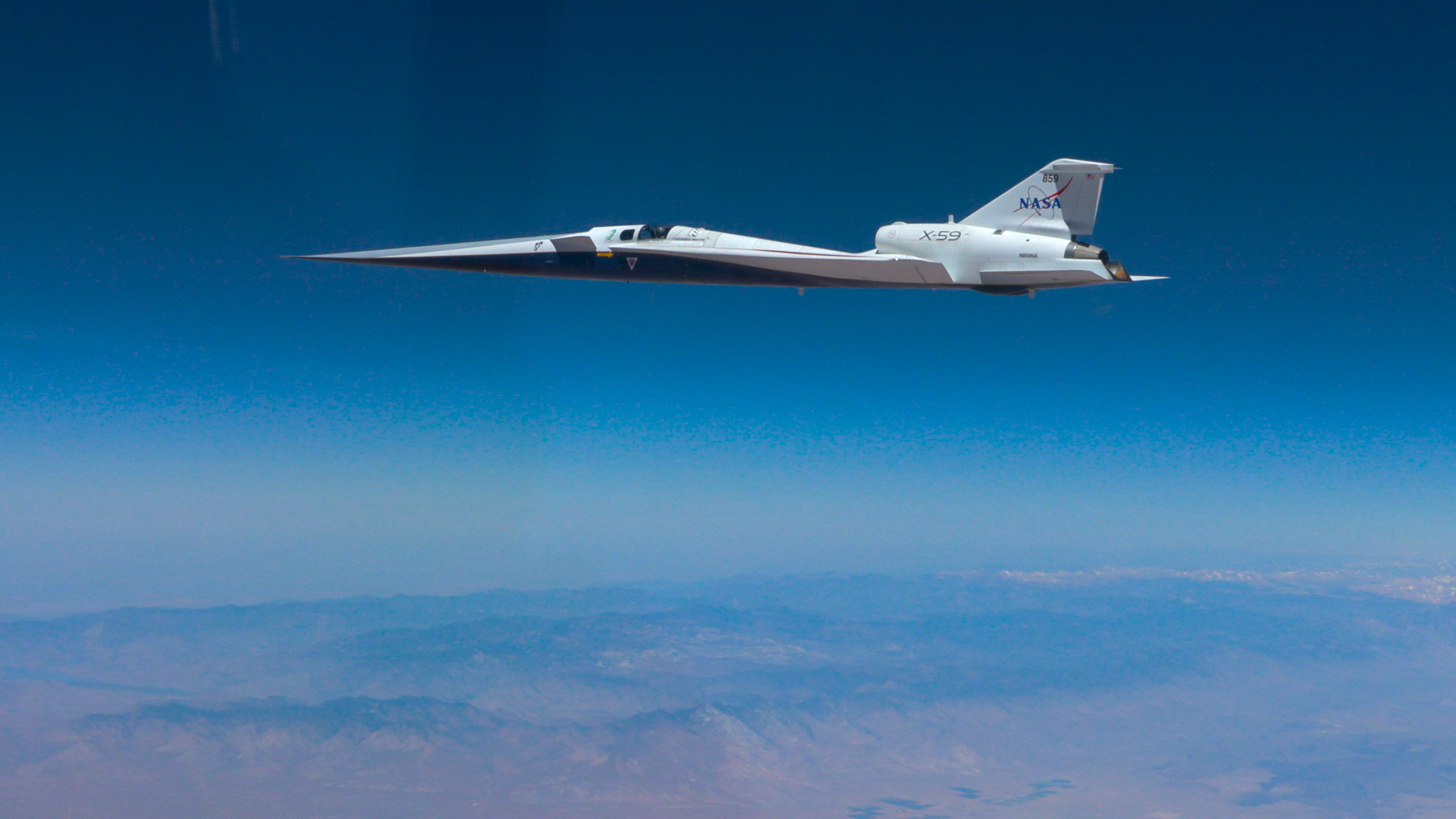
NASA's experimental X-59 aircraft successfully completed its first supersonic flight on June 5, 2026, marking a significant step towards potentially reviving overland supersonic travel. The aircraft, developed by Lockheed Martin in partnership with NASA, is engineered to transform the typically disruptive sonic boom into a much quieter 'thump' or 'whoosh' sound, comparable to a car door closing.

The X-59's unique design, featuring a long, tapered nose that constitutes nearly a third of its length, is crucial to this noise reduction. This aerodynamic shape is intended to manage and break up the shockwaves generated at supersonic speeds, preventing them from merging into a loud boom. Instead, the shockwaves are spaced out and weakened, resulting in a sound level closer to 75 perceived level in decibels (PldB), a stark contrast to the Concorde's approximately 105 PldB.

Piloting the X-59 presents unique challenges, notably the absence of a forward-facing window due to its elongated nose. Pilots rely on an advanced eXternal Vision System (XVS), which uses high-resolution cameras to display a forward view on a 4K monitor, augmented with flight data. Test pilots Jim Less and David Nils Larson underwent extensive simulator training, accumulating hundreds of hours and practicing numerous landings to adapt to this system.

NASA's ambitious plan includes taking the X-59 on a national tour across the United States. This tour aims to gather feedback from residents in various communities regarding the perceived noise of the quieter sonic thumps. This public input is vital as the US Congress is currently considering legislation that could lift the 1973 ban on overland supersonic flight, a ban that stemmed from public complaints during earlier military supersonic tests.

While the X-59 program demonstrates the technical feasibility of quieter supersonic flight, the revival of commercial supersonic air travel would still face significant financial hurdles, particularly concerning the high fuel consumption costs associated with such aircraft.

Frequently asked questions

The main goal is to demonstrate that supersonic flight can be achieved with a significantly reduced sonic boom, often described as a 'thump' or 'whoosh'.

The aircraft's design features a very long, tapered nose that is essential for shaping shockwaves, which obstruct the pilot's forward view, necessitating an external vision system.

The Concorde produced a sonic boom around 105 PldB, while the X-59 aims for a quieter thump closer to 75 PldB.

The ban prohibited supersonic flight over land in the US due to public backlash from noise complaints during earlier military tests, and current legislation aims to reverse this.

What Happens Next

01NASA plans to conduct a national tour of the X-59 aircraft.
02Residents in various US cities will provide feedback on the aircraft's sonic thumps.
03US Congress may pass legislation to legalize overland supersonic travel.

Get the newsletter.

Pick the topics you actually care about. We'll email when there's news worth your time, on the cadence you choose. Cancel any time from your account.

Cadence

How It Developed

NASA's X-59 quiet supersonic research aircraft completed its first supersonic flight on June 5, 2026.
The X-59 is designed to break up shockwaves to create a quieter sonic thump instead of a loud sonic boom.
The aircraft utilizes an eXternal Vision System (XVS) due to its long, tapered nose lacking a forward window.
NASA plans a national tour for the X-59 to gather public feedback on its sonic thumps.
US Congress is advancing legislation that could legalize overland supersonic travel, reversing a 1973 ban.

Sources

T1
NASA’s X-59 “frankenjet” tests supersonic flight without the sonic boomvar abtest_2160739 = new ABTest(2160739, 'impression');Ars Technica

Related Stories

China tests shape-shifting hypersonic ramjet
29 Jun · 12:05 PM
NASA and Katalyst Space Technologies collaborate on mission to save Swift telescope
28 Jun · 12:50 PM
Tesla FSD Faces Scrutiny Amid Fatal Crashes and Investigations
28 Jun · 4:25 PM
Japanese Firms Innovate Cooling Tech Amidst Rising Heat Concerns
29 Jun · 2:35 AM
California inks deal with Anthropic to expand AI use in government
29 Jun · 12:06 PM