HomeEverything
Equities & FundsCrypto & Digital AssetsAI & TechnologyBusiness & CorporateUS Politics & PolicyGeopolitics & Global RiskMacro, Rates & FXCommodities & EnergyEuropean Politics & MarketsAsia-PacificReal Estate & Property
← All Stories

Martian rock shows complex carbon, origin unclear

Created at 4 Jul · 11:05 AM1 source↑ Market-relevant
IN SHORT

NASA's Perseverance rover detected complex macromolecular carbon on the surface of a Martian rock at the Bright Angel site. While such carbon on Earth often indicates biological origins, scientists are cautious, noting that abiotic processes could also be responsible. Samples may need to be returned to Earth for definitive analysis.

✉Newsletter

PiQ Daily

Pick your topics. Get only what matters, on your cadence.

Key Numbers

five yearsPerseverance rover's time traversing Jezero Crater
four targetstargets examined at Bright Angel site
sols 1180 and 1218period of SHERLOC's examination

Who's Involved

Ashley E. Murphy
lead author of the study and researcher at the Planetary Institute
Kyle Uckert
SHERLOC's deputy principal investigator at NASA's JPL
Kevin P. Hand
Perseverance principal investigator at JPL
NASA’s Perseverance rover
rover that detected organic carbon on Mars
SHERLOC
instrument used for carbon detection
Martian rock shows complex carbon, origin unclear

↳ Why This Matters

The discovery of complex carbon on Mars' surface raises the possibility of past biological activity, a key objective of the Perseverance mission. Definitive identification of life's origins would be a monumental scientific breakthrough, fundamentally altering our understanding of life in the universe.

Key facts

  • NASA's Perseverance rover detected complex macromolecular carbon on the surface of a Martian rock.
  • The carbon signature, known as the graphitic band (G-band), indicates a network of reduced carbon atoms.
  • The material is resistant to chemical and thermal breakdown and roughly matches terrestrial kerogen.
  • Researchers ruled out instrument hardware malfunction and rover contamination as sources for the signal.
  • The carbon's association with different mineral types suggests multiple emplacement events.
  • Further analysis of returned samples is needed to determine if the carbon is of biological or abiotic origin.

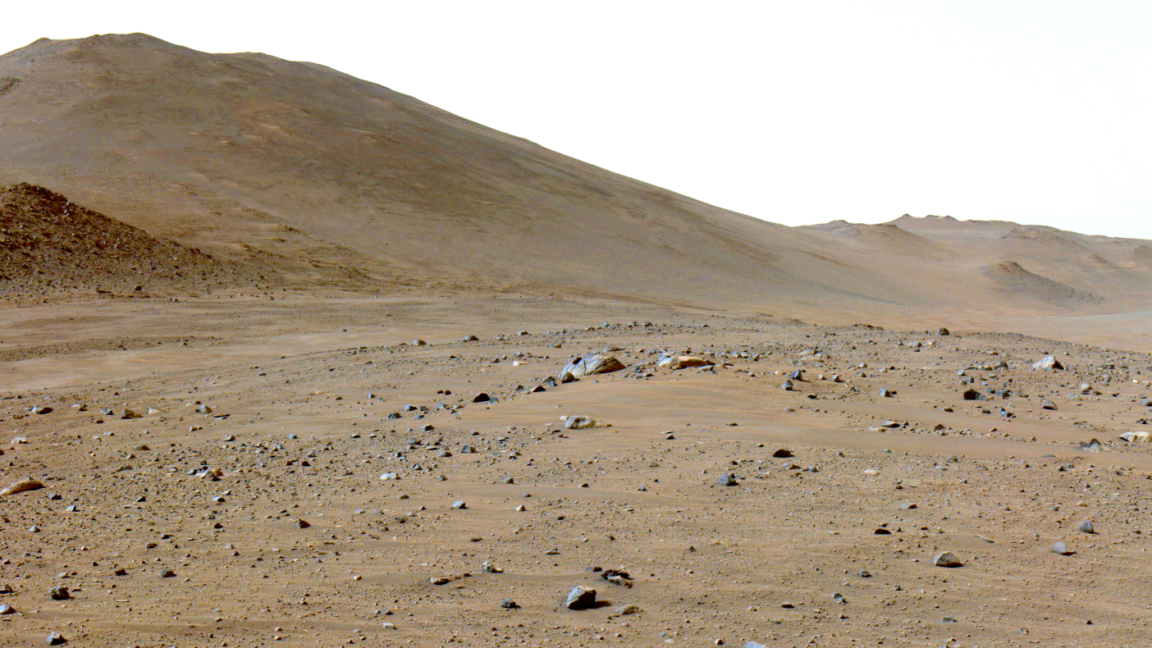
NASA's Perseverance rover has detected complex macromolecular carbon on the surface of a Martian rock at the Bright Angel site, an outcrop on the edge of the Neretva Vallis ancient river channel. This marks the shallowest detection of organic matter on the Martian surface to date. The discovery was made using the SHERLOC instrument, which analyzes light reflected from a target after being hit by a UV laser. Scientists identified a spectroscopic signature indicating a tangled, cross-linked network of reduced carbon atoms resistant to breakdown, similar to terrestrial kerogen. However, researchers are hesitant to label it as biogenic, as the term kerogen implies a biological origin, and they are considering abiotic processes as well. Initial concerns about the signal originating from the instrument's hardware or from contamination brought by the rover were addressed through rigorous testing and control measurements, including examining spare optics and known calibration targets, and noting that nearby rocks did not show the same signal. The abrasion bit used by the rover was sterilized before launch and had not produced such a strong signal in previous uses. Furthermore, one rock target was analyzed after simply being cleared of dust with nitrogen, without physical contact from the rover's hardware. The chemical analysis of the material adjacent to the carbon suggests that its emplacement may have occurred during at least two distinct geological events. At one site, the carbon signal clustered with carbonate and sulfate minerals, indicative of precipitation from water, while at another, it was found within silicate-rich sediment. This suggests a history involving organic matter settling into ancient lake mud and later being altered by groundwater. Ultimately, distinguishing between a biological and abiotic origin will likely require sample return to Earth, where more advanced techniques can be employed to analyze isotopic signatures, chirality, and potential microfossils. Scientists noted that the Perseverance rover's instruments are designed to identify compelling samples for return, rather than definitively determine the origin of organic compounds on Mars.

Frequently asked questions

The rover detected complex macromolecular carbon on the surface of a Martian rock at the Bright Angel site.

On Earth, such carbon often suggests a biological origin, raising questions about potential past life on Mars.

Yes, scientists acknowledge that abiotic processes, such as fluid-rock reactions, could also create such organic compounds.

The SHERLOC instrument on Perseverance used a UV laser to analyze the rock's surface, identifying a specific spectral signature.

Not yet. Definitive answers may require returning samples to Earth for more advanced analysis.

What Happens Next

01Samples collected by Perseverance may be returned to Earth for further analysis.
02Future analysis on Earth could examine isotopic signatures and chirality of the carbon.
03Advanced microscopes may be used to search for ancient microbial fossils in returned samples.

Get the newsletter.

Pick the topics you actually care about. We'll email when there's news worth your time, on the cadence you choose. Cancel any time from your account.

Cadence

How It Developed

Perseverance rover detected complex macromolecular carbon on a Martian rock surface.
The carbon was found at the Bright Angel site, near an ancient river channel.
The detection was made using the SHERLOC instrument, which uses a UV laser.
Researchers confirmed the signal was not from the instrument hardware or rover contamination.
The carbon's chemical signature suggests it may have been emplaced during at least two separate geological events.
The exact origin of the carbon, whether biological or abiotic, remains undetermined.
Scientists hope to analyze isotopic signatures and chirality of returned samples to determine origin.

Sources

T1
A martian rock has lots of carbon on it, and it’s not clear whyvar abtest_2161729 = new ABTest(2161729, 'impression');Ars Technica

Related Stories

SpaceX nears 1000th launch as Indian startup eyes first orbital flight
3 Jul · 2:05 PM
Claude Fable 5 Performance Unchanged, Safety Classifier Causes Routing Issues
3 Jul · 9:10 PM
NASA Swift Observatory Rescue Mission Delayed by Software Glitch
3 Jul · 1:20 PM
World's largest digital camera begins mapping universe from Chile
4 Jul · 4:50 AM
OpenAI's Stargate UK Project Faces Scrutiny Over Site Visits and Hypothetical Investment
4 Jul · 12:05 PM