All NewsEducationTV
Equities & FundsCrypto & Digital AssetsAI & TechnologyBusiness & CorporateUS Politics & PolicyGeopolitics & Global RiskMacro, Rates & FXCommodities & EnergyEuropean Politics & MarketsAsia-PacificReal Estate & Property
Story archiveAll categories
← All Stories

China advances AI in healthcare to boost efficiency and access

Created at 3 Aug · 8:21 AM1 source↑ Market-relevant
IN SHORT

China is accelerating the integration of AI across its digital healthcare ecosystem to improve medical efficiency and accessibility. The country aims to become a leader in AI applications, particularly in biomedicine, leveraging policy support and a vast data foundation.

✉Newsletter

PiQ Daily

Pick your topics. Get only what matters, on your cadence.

Key Numbers

300medical large models released
68 millionremote medical imaging cases handled
93%accuracy rate of "Agent Hospital" AI system
1.2 trillion yuanChina's AI core industry value by 2025
$174 billionChina's AI core industry value by 2025
21departments covered by "Agent Hospital" AI system
300disease scenarios for "Agent Hospital" AI system
100-foldincrease in diagnostic efficiency for primary care hospitals

Who's Involved

Ge Minghua
National lawmaker and director of Zhejiang Provincial People's Hospital
Huo Yong
National political advisor and chief cardiology expert at Peking University First Hospital
Zhu Tongyu
National political advisor and vice president of Shanghai Medical College of Fudan University
Ding Lieming
National political advisor and member of the Chinese Peasants and Workers Democratic Party
Tsinghua University’s Institute for AI Industry Research (AIR)
Developed the "Agent Hospital" AI system
China advances AI in healthcare to boost efficiency and access

↳ Why This Matters

China's aggressive push into AI-powered healthcare signifies a potential new global growth engine for the country, addressing both domestic healthcare challenges and offering a model for other nations, particularly within the BRICS and Global South, seeking to improve medical efficiency and access amidst rising demand and workforce shortages.

Key facts

  • China is integrating AI into its healthcare system to enhance efficiency and accessibility.
  • The country aims for a leading strategic position in AI industry applications by 2030.
  • Approximately 300 medical large models have been released as of May 1, 2025.
  • Remote medical imaging services have handled over 68 million cases at the county level.
  • An AI system, "Agent Hospital," can perform diagnoses with over 93% accuracy in minutes.
  • China's AI core industry was valued at over 1.2 trillion yuan ($174 billion) by 2025.

China is significantly advancing its AI-powered digital healthcare sector, aiming to enhance medical efficiency and broaden access to quality services. This initiative is a core component of national strategies, including the "Healthy China Initiative" and the "AI Plus Initiative."

The country's 15th Five-Year Plan (2026-2030) emphasizes achieving a leading strategic position in AI industry applications, with biomedicine identified as a key emerging pillar industry. Government reports also highlight the encouragement of large-scale commercial AI applications in critical sectors.

AI is already transforming healthcare through applications like AI-assisted diagnosis, smart health platforms, and analysis of routine scans for early detection of diseases. Personalized cancer vaccines developed using AI are expected to be available soon. As of May 1, 2025, China had released around 300 medical large models, and remote medical imaging services at the county level had processed over 68 million cases.

Experts believe that digital technologies are crucial for improving healthcare delivery and reducing disparities in medical resources between urban and rural areas. The integration of AI is seen as a vital engine for developing new, high-quality productive forces within the health sector. Portable AI diagnostic devices are enabling remote patient monitoring, supporting tiered healthcare services and optimizing resource distribution.

Globally, healthcare systems face challenges from aging populations, chronic diseases, and unequal resource distribution, leading to a significant shortage of healthcare workers. AI is emerging as a critical solution. In China, the "Agent Hospital" system, developed by Tsinghua University’s Institute for AI Industry Research, can perform end-to-end diagnosis and treatment decisions across numerous departments and disease scenarios with high accuracy, completing tasks in minutes that would take human doctors hours. This system aims to "algorithmize expert experience" and serve as a "digital hub" for medical institutions, moving beyond single applications to systemic integration.

By 2025, China's AI core industry was valued at over 1.2 trillion yuan (approximately $174 billion), with the integration of big data, AI, IoT, and 5G expected to drive growth across the entire medical industry chain.

Frequently asked questions

The "AI Plus Initiative" is a Chinese government strategy aimed at encouraging the large-scale commercial application of AI in key sectors and fields, including healthcare and biomedicine.

The "Agent Hospital" is an AI system developed by Tsinghua University's Institute for AI Industry Research capable of end-to-end diagnosis and treatment decisions across multiple departments and disease scenarios with high accuracy.

By 2025, China's AI core industry was projected to reach over 1.2 trillion yuan (approximately $174 billion).

What Happens Next

01China aims to obtain a leading strategic position in AI industry applications from 2026 to 2030.
02The country will continue to advance and expand the "AI Plus Initiative."

Get the newsletter.

Pick the topics you actually care about. We'll email when there's news worth your time, on the cadence you choose. Cancel any time from your account.

Cadence

How It Developed

AI-powered apps are helping millions in China manage health and seek care.
AI analysis of scans detects cancers and other conditions.
Personalized cancer vaccines built on AI analysis are nearing production.
China is embedding AI across its digital healthcare ecosystem to boost efficiency and access.
The 15th Five-Year Plan emphasizes obtaining a leading strategic position in AI industry applications from 2026 to 2030.
The government work report vows to advance the "AI Plus Initiative" and encourage large-scale AI commercial application.
Biomedicine is recognized as an emerging pillar industry.
Digital technologies are seen as key to reshaping healthcare delivery and narrowing the urban-rural gap in medical resources.

Sources

T1
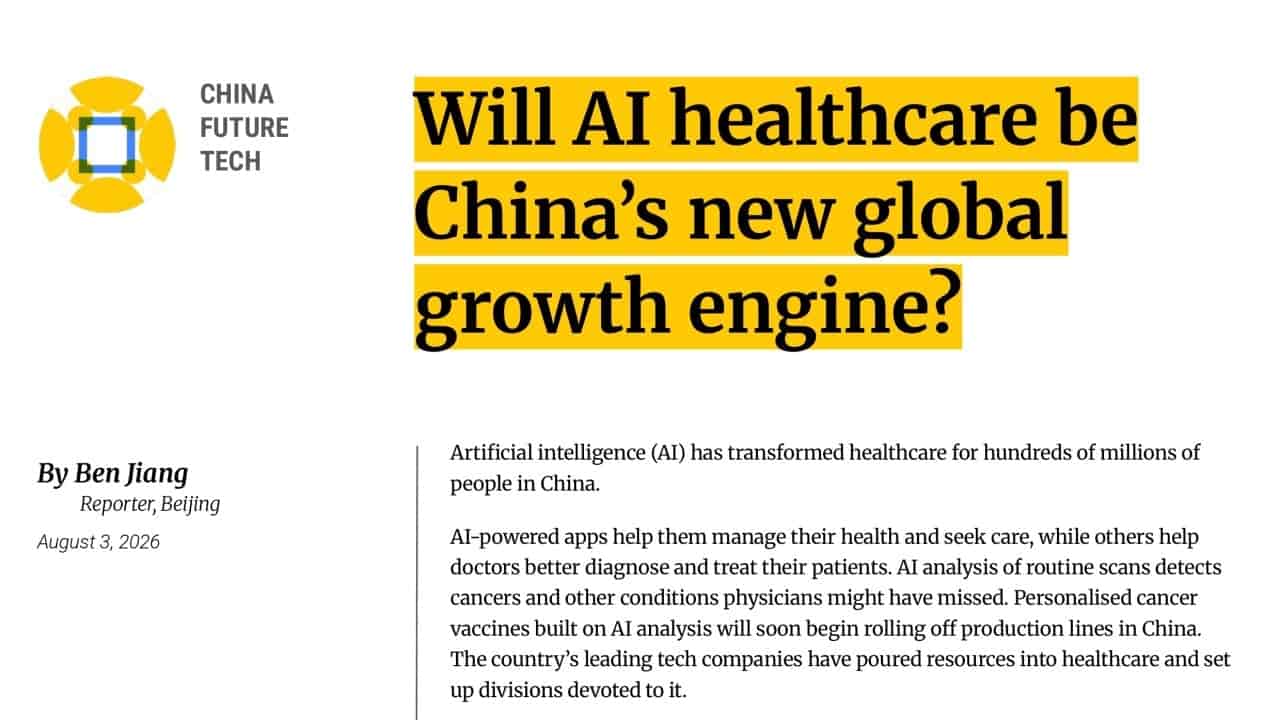
Will AI healthcare be China’s new global growth engine?South China Morning Post
T2
China advances AI-powered digital healthcare for higher medical ...english.scio.gov.cn
T2
China's Medical AI: A New Engine for Digital Healthideas-brics.org
T2
Artificial intelligence in Chinese healthcare: a review of applications ...link.springer.com

Related Stories

China's Tech Giants Integrate AI Into Delivery Rider Helmets
3 Aug · 7:05 AM
AI chip market volatility highlights opaque economy
2 Aug · 9:11 AM
US ban on Chinese AI models could cost businesses $12B annually: report
3 Aug · 3:10 AM
DeepSeek's V4-Flash AI model is cheapest to run among known models, research says
3 Aug · 5:44 AM
Alibaba's Qwen AI model performance questioned amid lack of benchmarks
3 Aug · 5:51 AM