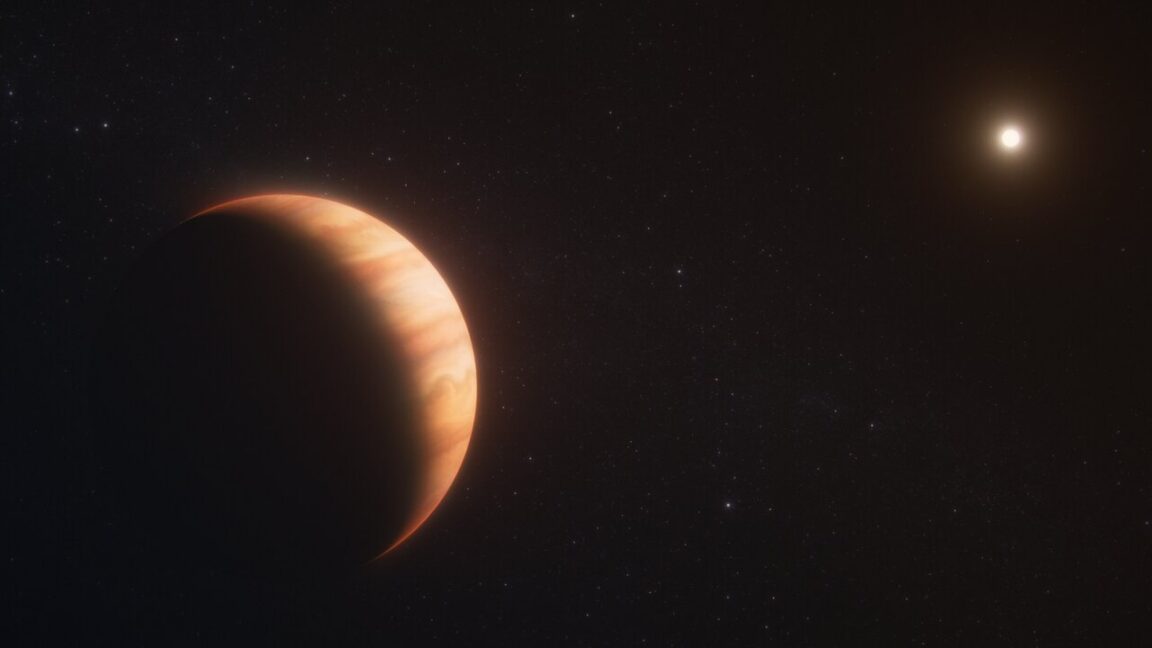
Key facts
- WD 1856 b is the only confirmed planet to survive the death of a Sun-like star.
- The planet is Jupiter-size and orbits a white dwarf, the remnant of a Sun-like star.
- JWST observations indicate the planet's atmosphere contains methane and aerosol hazes.
- WD 1856 b is significantly hotter than expected, emitting more energy than it receives from its star.
- Scientists suggest the planet's heat is residual from its migration process, likely influenced by gravitational interactions with companion stars.
Astronomers have used the James Webb Space Telescope (JWST) to study WD 1856 b, a gas giant planet that has uniquely survived the death of its Sun-like star. This planet is the only confirmed case of a world that outlived its star's red giant phase and now orbits a white dwarf, the dense remnant of a star like our Sun.
The discovery, initially made by the TESS observatory in 2020, presented a puzzle because WD 1856 b orbits its white dwarf at a mere 0.02 AU, a distance that contradicts current models of stellar evolution. Typically, when a star expands into a red giant, it consumes inner planets, and as it shrinks to a white dwarf, its gravitational pull weakens, causing outer planets to migrate further away. WD 1856 b, however, appears to have migrated closer to its star.
JWST observations, conducted in April 2023, focused on a single transit of the planet. Due to the unusual viewing angle, where the planet only grazes the face of the star, astronomers had to develop new equations and modify existing software to analyze the transmission spectrum and reconstruct the planet's atmosphere. The analysis revealed that WD 1856 b is shrouded in aerosol hazes and contains methane.
Furthermore, the planet is significantly hotter than anticipated, radiating approximately 25 times more energy than it receives from its cooling host star. This suggests an internal heat source, rather than simply re-radiating stellar energy. Scientists, including theoretical astrophysicist Christopher O’Connor, propose that this heat is residual from the planet's migration process, which likely occurred 3 to 5.5 billion years after the star's red giant phase. This timing points towards gravitational interactions with companion stars as the cause of the inward spiral.
However, a caveat exists: the planet's high methane content (7%) might have skewed the cooling models, which were based on Jupiter-like atmospheric compositions (around 0.3% methane). Further research with new models tailored to WD 1856 b's specific atmospheric makeup may be necessary. The proximity of WD 1856 b, just 75 light-years away, suggests that more such planetary survivors might be waiting to be discovered.