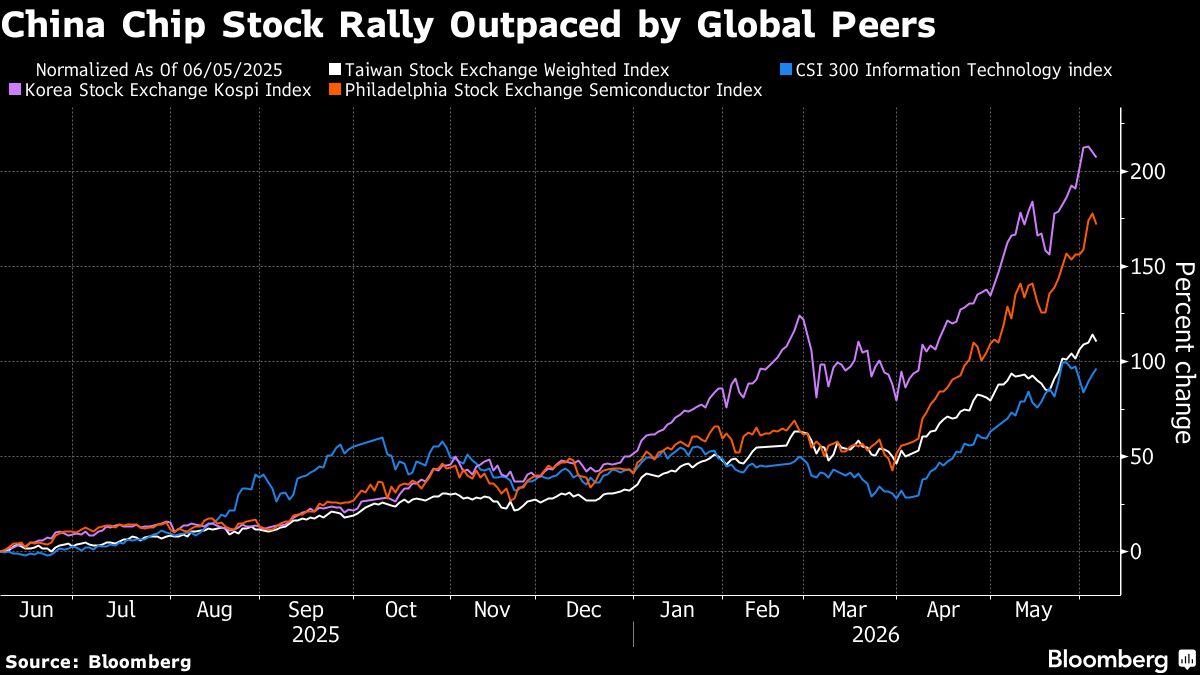
South Korean stocks are adopting a cautious stance as market concentration in AI chip giants like Samsung Electronics and SK Hynix prompts investors to seek opportunities elsewhere in the AI supply chain. Meanwhile, China's semiconductor industry is making strides in AI model training with Huawei's Ascend 910C chips, aiming to enhance self-reliance amidst US sanctions. This AI boom is drawing significant institutional capital, leading some, like Bitwise CIO Matt Hougan, to view cryptocurrency as a contrarian investment. Chinese memory chip makers are also advancing, posing a potential long-term challenge to South Korean leaders.

South Korean stocks are transitioning from optimism to caution, driven by the market's heavy concentration in a few dominant AI chip companies, notably Samsung Electronics and SK Hynix. Investors are reportedly trimming their positions in these giants and exploring opportunities further down the AI supply chain. This shift is partly fueled by concerns about a potential market correction, especially if interest rates were to rise.
In parallel, China's semiconductor sector is demonstrating progress in AI model development. A research team, which includes Huawei, has successfully utilized the company's Ascend 910C chips to complete post-training for the DeepSeek-V4-Pro AI model. This achievement represents a notable advancement for China's domestic semiconductor industry, particularly in the complex domain of AI model training. The initiative aligns with China's broader goal of reducing its reliance on foreign technology, a strategy intensified by ongoing US sanctions.
This intense focus on artificial intelligence and robotics stocks is also reshaping investment landscapes in other sectors. Bitwise Chief Investment Officer Matt Hougan observes that cryptocurrency is emerging as a contrarian investment bet. He notes that with major indices like the Nasdaq-100 experiencing significant gains, crypto is no longer the primary focus for institutional capital. This redirection of investor attention is creating a more challenging market environment for digital assets.
Furthermore, China's memory chip manufacturers are signaling a long-term competitive challenge to established South Korean players. Companies such as CXMT are progressing towards public listings, indicating their ambition to grow and compete on a larger scale. While analysts suggest the immediate threat to South Korean giants like Samsung Electronics and SK Hynix is limited, the development signifies a growing ambition within China's domestic chip industry.
South Korean stocks are transitioning from optimism to caution, driven by the market's heavy concentration in a few dominant AI chip companies, notably Samsung Electronics and SK Hynix. Investors are reportedly trimming their positions in these giants and exploring opportunities further down the AI supply chain. This shift is partly fueled by concerns about a potential market correction, especially if interest rates were to rise.